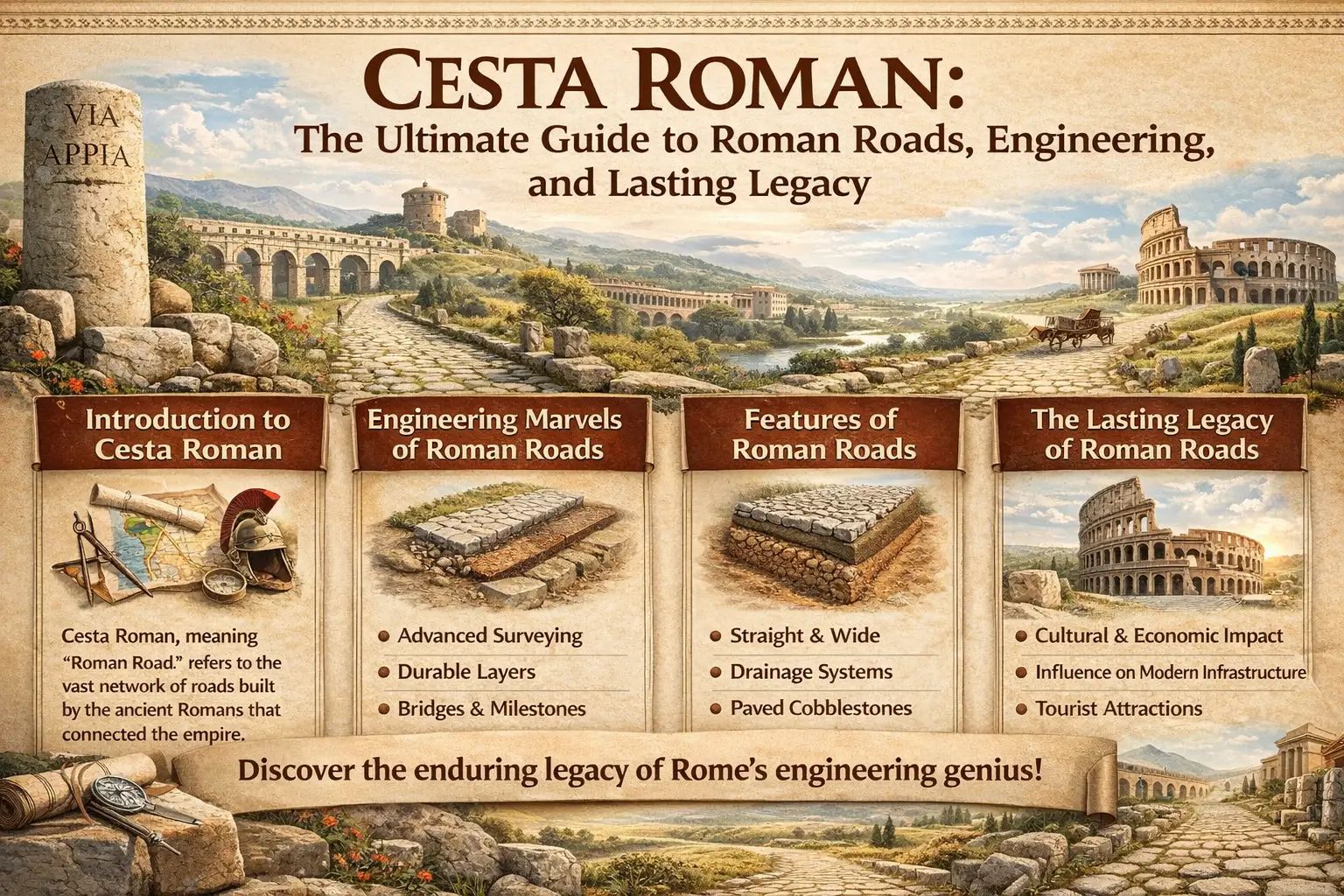
Introduction: Understanding the Cesta Roman
Imagine walking along an ancient stone path, worn smooth by centuries of travelers, merchants, and soldiers. This is the experience offered by the Cesta Roman, also known as Roman roads. These remarkable engineering feats were more than just transportation routes—they were lifelines of the Roman Empire, connecting cities, enabling trade, and spreading culture across continents. Today, the Cesta Roman continues to captivate historians, engineers, and travelers alike.
The term “Cesta Roman” combines linguistic, historical, and cultural meanings. While in Slavic languages like Slovenian and Croatian, “cesta” simply means road, in Latin and Romance languages, it can also mean basket, derived from the word cista. In this guide, we will explore the roads themselves, their historical significance, engineering brilliance, cultural impact, and the best ways to experience them today.
What Does “Cesta Roman” Mean?
The Slavic Interpretation: Road in Central Europe
In Central Europe, particularly Slovenia and Croatia, Cesta Roman refers to the Roman roads that traversed these regions. Known locally as Rimska Cesta, these roads were vital arteries of commerce, military movement, and governance. They connected remote provinces to the heart of Rome, enabling swift travel and communication across the vast empire.
The Latin Connection: Basket (Cista) Symbolism
Interestingly, “cesta” in Latin and Romance languages can also refer to a woven basket, or cista, used for storage, agricultural harvesting, and ceremonial purposes. While this meaning is secondary, it highlights the human element of the roads: soldiers, merchants, and everyday citizens carried goods in their cistas along these very paths.
A Brief History of the Roman Road System
The Roman road system was one of the most extensive and advanced networks of the ancient world. It began around 312 BCE with the construction of the Via Appia, connecting Rome to Brindisi in southern Italy. Over the centuries, the network expanded to cover an estimated 400,000 km, including about 80,000 km of paved roads, reaching territories across Europe, North Africa, and the Middle East.
These roads were essential for the Roman Empire’s cohesion. They allowed armies to move rapidly, merchants to trade efficiently, and administrators to govern vast and diverse regions. Without these roads, the empire’s provinces would have remained fragmented and isolated.
Engineering Excellence: How the Romans Built Roads
Roman roads were not merely paths—they were masterpieces of engineering. Their longevity, with many still visible today, is a testament to the Romans’ meticulous construction techniques.
Multi‑Layered Construction Techniques
A typical Cesta Roman road consisted of multiple layers designed for durability and stability:
- Fossa: A trench dug to solid ground or bedrock.
- Statumen: A foundation of large stones providing structural support.
- Rudus: A layer of crushed stones mixed with lime or clay for shock absorption.
- Nucleus: Fine gravel or sand to level the surface.
- Summum Dorsum: Large, interlocking paving stones forming a smooth, durable top layer.
This layered approach allowed Roman roads to withstand centuries of weather, traffic, and natural wear.
Drainage, Camber, and Durability
Roman engineers understood that water was the enemy of longevity. They built roads with a slight camber, or curve, so rainwater would drain into side ditches, preventing erosion and mud accumulation. Bridges, tunnels, and retaining walls were incorporated where necessary, demonstrating advanced surveying and construction knowledge.
Major Roman Roads and Famous Routes
The Cesta Roman network included some of the most iconic roads in history:
Via Appia (Appian Way)
Constructed in 312 BCE, the Via Appia connected Rome to Brindisi. Known as the “Queen of Roads,” it was crucial for military campaigns and trade in southern Italy.
Via Aurelia
Stretching along Italy’s western coast to Liguria and Gaul, the Via Aurelia facilitated both military movement and maritime trade.
Via Flaminia
Connecting Rome to the Adriatic Sea, the Via Flaminia was one of the most traveled roads during the Republican and Imperial periods.
Other Notable Roads Across Europe
Roman roads also extended into present-day Spain, France, Britain, and the Balkans, creating a vast network that underpinned the empire’s economic and military strength.
The Cesta Roman in Central Europe
Central Europe, particularly Slovenia and Croatia, hosts several well-preserved remnants of Roman roads. One of the most remarkable is the Logatec Trail in Slovenia. Here, deep ruts in limestone bear witness to centuries of carts, horses, and travelers. Walking this trail offers a tangible connection to the past, where the footprints of history are literally etched into the stone.
Role in Trade and Commerce
Roman roads were vital trade arteries. Goods such as olive oil, wine, grain, pottery, and textiles moved efficiently across provinces. The Amber Road, for instance, transported Baltic amber to the Mediterranean, with sections overlapping the Cesta Roman in Central Europe. These routes enabled early globalization, allowing goods, culture, and ideas to flow freely.
Military Importance of Roman Roads
The military was a primary motivator behind Roman road construction. Legions relied on these roads for rapid deployment, supply transport, and strategic maneuvering. Forts, watchtowers, and waystations along the roads ensured that troops were supported and that Rome could maintain control over distant territories.
Cultural and Social Influence
Beyond trade and warfare, the Cesta Roman facilitated cultural integration. Travelers spread Roman law, language, religion, and art across provinces. Pilgrims, merchants, and scholars used these roads, weaving a shared cultural fabric that linked distant regions under Roman governance.
Visiting Cesta Roman Today
Hiking and Heritage Tourism
Modern travelers can explore Cesta Roman remnants on foot. Hiking these trails offers a slow-travel experience, connecting visitors with history in a way no museum can replicate.
Best Times and Essential Gear
- Best Time: Spring and autumn, when weather conditions are favorable.
- Gear: Sturdy hiking boots, maps or GPS, water, and provisions.
Responsible Travel and Preservation
Cesta Roman sites are protected heritage landmarks. Visitors should take only photographs, leave only footprints, and avoid removing stones or artifacts.
Legacy: From Ancient Paths to Modern Roads
Many modern highways in Europe trace the paths of Roman roads, a testament to their strategic planning and engineering precision. The Cesta Roman influenced urban planning, transportation networks, and infrastructure development for centuries, demonstrating the enduring value of Roman ingenuity.
Key Facts and Figures
| Feature | Detail |
|---|---|
| Network length | 400,000 km estimated (80,000 km paved) |
| First major road | Via Appia (312 BCE) |
| Construction layers | Fossa, Statumen, Rudus, Nucleus, Summum Dorsum |
| Central European remnants | Logatec Trail, Slovenia |
| Trade routes | Amber Road connection |
| Modern influence | Many European highways follow Roman routes |
Frequently Asked Questions (FAQs)
Q1: What is a Cesta Roman?
A: It is the ancient Roman road system built to connect territories across the Roman Empire.
Q2: Where can you find Roman roads today?
A: Central Europe (Slovenia, Croatia), Italy, Britain, France, and other parts of the former empire.
Q3: How were Roman roads built to last so long?
A: Multi-layered construction, precise drainage, durable paving stones, and strategic surveying ensured longevity.
Q4: Are any Roman roads still in use today?
A: Yes, many modern roads follow ancient Roman routes, and some original paving stones remain visible.
Q5: What was the primary purpose of Roman roads?
A: Military movement, trade, communication, governance, and cultural integration.
Conclusion
The Cesta Roman is more than just an ancient roadway—it is a symbol of human ingenuity, cultural integration, and historical continuity. From engineering marvels to trade arteries and military highways, these roads shaped the Roman Empire and continue to influence modern infrastructure. Today, walking a Cesta Roman is not only a journey through Europe’s landscapes but also a walk through the pages of history, where every stone tells a story.
Read About:- What Is Nerwey?