What Is Duaction?
Definition and Meaning of Duaction
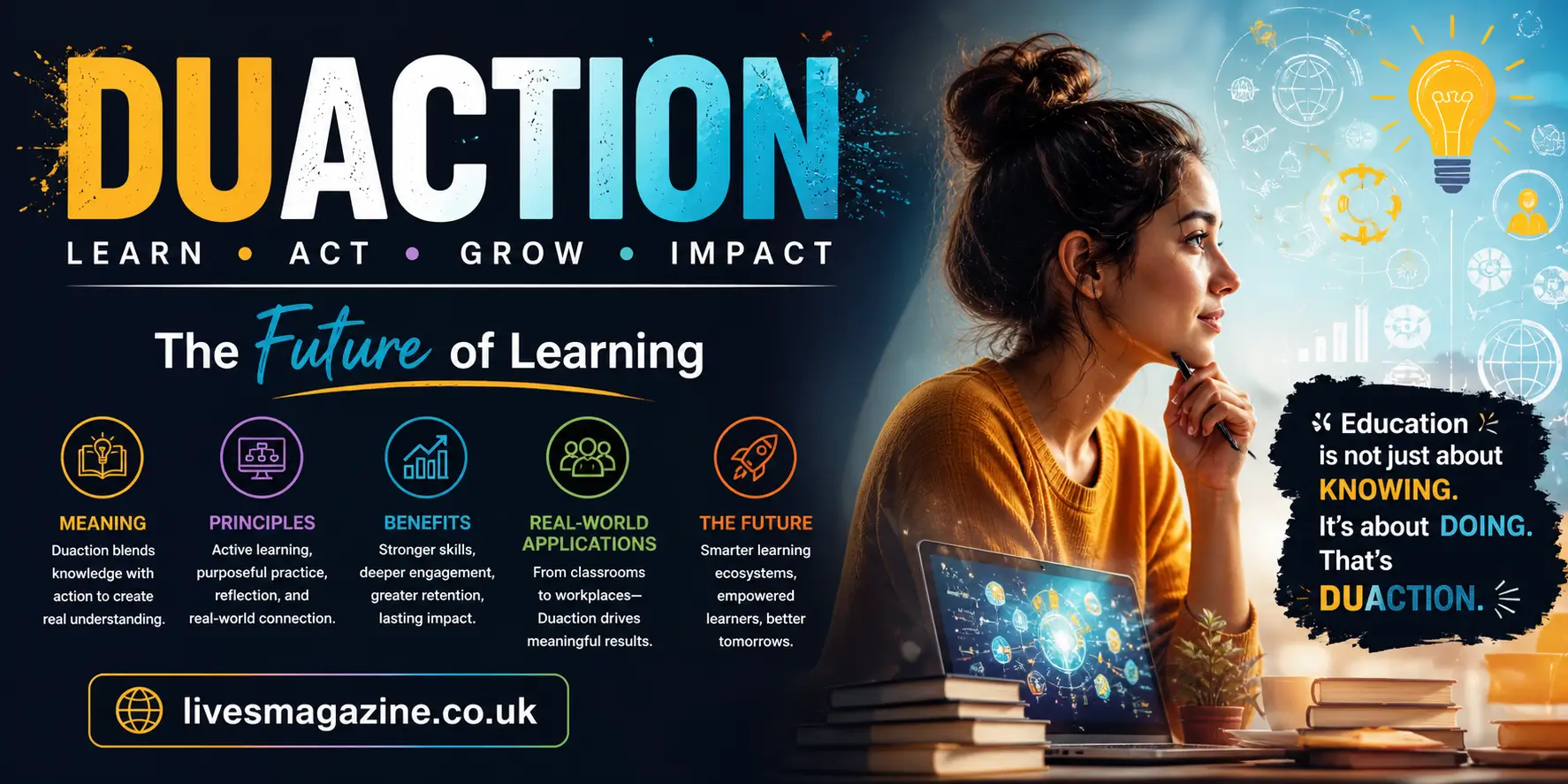
Duaction is a blended educational approach that simultaneously combines theoretical learning with practical action. Unlike traditional models where students first learn theory and then apply it later, Duaction dissolves that barrier by encouraging learners to apply what they’ve learned as they learn it. This fusion creates a fluid cycle of theory, practice, feedback, and reflection — accelerating understanding and skill acquisition.
In essence, Duaction formalizes the idea of learning by doing into a coherent educational philosophy and methodology. It empowers learners not just to know concepts, but to live them, use them, test them, and adapt them in real environments.
Origin of the Term “Duaction”
The word Duaction is derived from a blend of “dual” and “action”, emphasizing its core idea: dual engagement in learning and doing. While not yet widely featured in academic literature, its foundations are grounded in well-established theories such as experiential learning, active learning, and constructivist education — all of which assert that active participation enhances cognitive outcomes.
Why Duaction Is Gaining Popularity in Modern Education
With rapid technological shifts, global job markets demanding real creativity and problem-solving skills, and students seeking education that matters, Duaction meets modern needs better than traditional models. Its focus on real-world relevance, skill readiness, and reflective learning makes it increasingly attractive to educators, employers, and learners alike.
The Core Philosophy Behind Duaction
At its heart, Duaction is rooted in active participation, experience, and reflection. Rather than treating education as a passive reception of facts, it views learning as an interactive journey of doing, testing, refining, and applying.
Learning by Doing Explained
Duaction’s foundation lies in what educational theorists like John Dewey and David Kolb described as learning by doing — that learners construct knowledge through direct experience, reflection, and action.
Research shows that experiential learning boosts comprehension and retention significantly. For example, individuals retain much more information when they are actively involved in the learning process — up to 90% of what they do compared to only 10–30% of what they read or hear.
Bridging Theory and Practice
Duaction eliminates the long gap between learning and application typical of conventional education. Instead, as soon as students learn a concept, they apply it — creating an immediate practice-theory loop that reinforces learning and builds practical competence.
Simultaneous Learning and Application
Rather than staging theory first and practice later, Duaction merges them in real time. This simultaneity leads to better knowledge retention, skill fluency, and confidence. Research shows that learners engaged in experiential learning demonstrate significantly higher retention and academic performance compared to traditional lecture-only groups.
The Role of Action in Knowledge Retention
Action isn’t just engagement — it triggers multiple cognitive processes. When knowledge is applied practically, it transfers from short-term memory into long-term understanding, which is crucial for lifelong learning and real-world problem solving.
Core Principles of Duaction
Duaction is guided by several powerful principles, each reinforcing its mission to unify learning and doing.
Active Engagement in Learning
Rather than passively absorbing information, learners participate — experimenting, testing, reflecting, and iterating. Active involvement increases comprehension and motivation.
Contextual and Experiential Learning
Duaction puts learning in context — whether through real projects, simulations, case studies, community involvement, or workplace experiences. This is consistent with situated learning philosophies that claim learning is most effective where it is applied.
Continuous Feedback and Improvement
Feedback is immediate and constructive, allowing learners to adjust, improve, and retry. This continuous feedback loop ensures that learners refine both understanding and skill.
Skill Development Alongside Theory
Instead of postponing skills for later, Duaction helps learners develop thinking, communication, teamwork, problem-solving, creativity, and technical competencies during the learning process itself.
Collaboration and Peer Learning
Learning with others promotes diversity of thought, reflection, and deeper insight. Duaction encourages group projects, discussions, teamwork, and knowledge sharing.
Duaction vs Traditional Learning Models
Understanding the power of Duaction is best achieved by direct comparison with conventional education.
| Aspect | Traditional Learning | Duaction |
|---|---|---|
| Theory vs Practice | Theory first, practice later | Integrated learning and doing |
| Student Role | Passive listener | Active participant |
| Retention | Often limited | Enhanced through application |
| Skill Development | Delayed till later stages | Continuous and dynamic |
| Relevance | Often abstract | Real-world tied |
| Feedback | Delayed | Immediate |
Student Engagement Comparison
Traditional classrooms often rely on lecture methods that lead to low participation. Conversely, Duaction’s active approach increases engagement significantly — research suggests a 30% rise in student engagement with experiential learning models.
Knowledge Retention and Recall
Experiential methods lead to deeper retention — studies suggest learners involved in hands-on activities retain significantly more knowledge than those taught by lecture alone.
Career Readiness and Practical Skills
Employers increasingly value practical readiness — with up to 90% of employers favouring experiential learning experiences in hiring decisions, indicating that graduates with Duaction-style experience land better career opportunities.
Key Benefits of Duaction in Education
Duaction delivers benefits across multiple dimensions: cognitive, emotional, professional, and societal.
Enhanced Knowledge Retention
Research shows that learning through activity increases retention rates substantially. Students retain more and forget less when knowledge is applied immediately.
Deeper Conceptual Understanding
When students apply concepts in real situations, they internalize meaning and develop a holistic understanding rather than memorizing facts.
Improved Critical Thinking Skills
Duaction requires students to analyze, reflect, and solve real problems — enhancing critical thinking and decision-making skills that are essential in all fields.
Increased Motivation and Confidence
When learners see the impact of their efforts, motivation increases. Studies show up to 60% rise in learner confidence through experiential methods.
Real-World Problem-Solving Ability
Duaction prepares learners to handle real challenges — whether in business, technology, healthcare, or community settings — making learning practical and purposeful.
Lifelong Learning Mindset
By incorporating feedback, reflection, and adaptive problem-solving, Duaction cultivates a habit of continuous learning that persists beyond formal education.
Psychological and Cognitive Foundations of Duaction
Duaction is more than a trend — it’s supported by established educational psychology.
Experiential Learning Theory (Kolb)
Kolb’s framework describes learning as a cycle of experience → reflection → conceptualization → experimentation, which mirrors Duaction’s process.
Constructivist Learning Theory
Learning is constructed in context, through action and reflection — aligning directly with Duaction’s emphasis on active participation and meaning-making.
Cognitive Science and Memory Retention
Active engagement activates multiple neural pathways, strengthening memory encoding and recall compared with passive learning.
Importance of Immediate Feedback
When learners apply knowledge and get feedback immediately, it accelerates learning loops — ultimately promoting mastery faster than passive knowledge acquisition.
Real-World Applications of Duaction
Duaction isn’t limited to traditional classrooms — it applies across fields and industries.
Duaction in Higher Education
Universities can integrate Duaction through internships, labs, field projects, and industry collaborations, turning classrooms into launchpads for careers.
Duaction in Corporate Training Programs
Companies can train employees through workshops tied to real tasks and ongoing reflection, increasing both productivity and skill acquisition.
Duaction in Vocational and Technical Education
Fields like nursing, engineering, and hospitality benefit immensely from Duaction — where simulation labs and hands-on modules prepare students for real duties.
Duaction in Digital and Online Learning
E-learning platforms now incorporate live projects, interactive tasks, and real-time feedback to ensure that remote learning is not just passive watching.
Duaction in Entrepreneurship and Innovation
Startups and innovation hubs thrive on trial, iteration, and real application — making Duaction a natural fit for entrepreneurial growth and problem-solving.
Duaction in Healthcare and Medical Training
Medical students engage in simulations and supervised hands-on care — improving clinical reasoning, confidence, and competence long before entering real practice.
Role of Educators in Duaction-Based Learning
To implement Duaction, educators must shift roles.
From Lecturer to Learning Facilitator
Teachers become guides — designing experiences, presenting real challenges, and nurturing reflection.
Designing Duaction-Friendly Curriculum
Curricula must blend theory with actions — projects, simulations, labs, and real tasks that reflect authentic challenges.
Encouraging Active Participation
Educators use group tasks, feedback loops, and reflective exercises to ensure that learners are involved, not passive.
Assessment in Duaction Models
Assessment moves beyond exams — focusing on portfolios, real tasks, competencies, reflections, and project outcomes.
Role of Parents in Supporting Duaction
Parents play a key role in reinforcing Duaction values.
Encouraging Practical Learning at Home
Activities like cooking, gardening, and planning trips can connect academic learning to real life.
Connecting School Learning to Everyday Life
Talking about real cases — like budgeting, planning, science experiments — helps children make connections beyond textbooks.
Building Confidence Through Hands-On Tasks
Celebrating small achievements encourages continued effort and curiosity.
Creating a Duaction-Friendly Learning Environment
For Duaction to thrive, the environment must support action.
Collaborative Learning Spaces
Spaces that encourage teamwork and discussion enhance knowledge construction.
Project-Based & Problem-Based Learning
Projects and real problems anchor learning in reality.
Use of Technology and Digital Tools
Simulations, interactive platforms, virtual labs, and AI can make Duaction accessible and scalable.
Real-World Simulations and Case Studies
Simulations mimic reality, giving learners safe spaces to practice and reflect before real tasks.
Challenges and Limitations of Duaction
While powerful, Duaction implementation isn’t without hurdles.
Infrastructure and Resource Needs
Duaction often requires labs, tech tools, and environments that schools may struggle to provide.
Curriculum Redesign Challenges
Traditional syllabi need transformation to integrate action-based components.
Teacher Training and Skill Gaps
Educators need support and training to shift from lecturers to facilitators.
Assessment and Evaluation Issues
Standardized tests may not capture practical competencies, requiring new evaluation systems.
Scalability in Large Institutions
Scaling Duaction for large student bodies demands digital platforms and innovative solutions.
Technology and the Evolution of Duaction
Digital tools are making Duaction more impactful.
Role of Artificial Intelligence (AI)
AI can offer personalized feedback, adaptive tasks, and simulated environments for practice.
Virtual Reality (VR) and Augmented Reality (AR)
VR/AR can simulate real environments for immersive learning experiences.
Interactive E-Learning Platforms
Platforms with live projects and real tasks ensure active participation even online.
Duaction and the Future of Learning
Duaction aligns with future educational and workforce needs — equipping learners with critical thinking, adaptability, creativity, empathy, and practical competence.
Industry Demand for Skill-Based Education
Employers consistently emphasize skill readiness — and Duaction prepares graduates who meet this demand.
Global Adoption of Duaction Models
More schools, universities, and organizations are integrating hands-on learning into core curricula.
Why Duaction Is a Future-Proof Approach
In a rapidly changing world, adaptability and applied experience matter more than memorization — and Duaction fosters exactly that.
Frequently Asked Questions About Duaction (SEO Booster)
Is Duaction better than traditional learning?
Yes — especially for retention, engagement, and real-world readiness.
Can Duaction be applied in online education?
Absolutely — with interactive platforms, real projects, and immediate feedback loops.
What skills does Duaction develop?
Critical thinking, problem-solving, communication, teamwork, creativity, adaptability, and more.
Is Duaction suitable for all age groups?
Yes — tailored projects and reflection activities can be adapted from elementary to professional levels.
Conclusion: Duaction as the Bridge Between Knowledge and Action
Duaction represents a transformative shift in how we view learning. Moving beyond passive lectures and rote memorization, it empowers learners to think deeply, act boldly, and reflect meaningfully. Supported by centuries of educational research and validated by modern data, Duaction isn’t just an idea — it’s the future of effective, relevant education.
Read More: Beit Bart