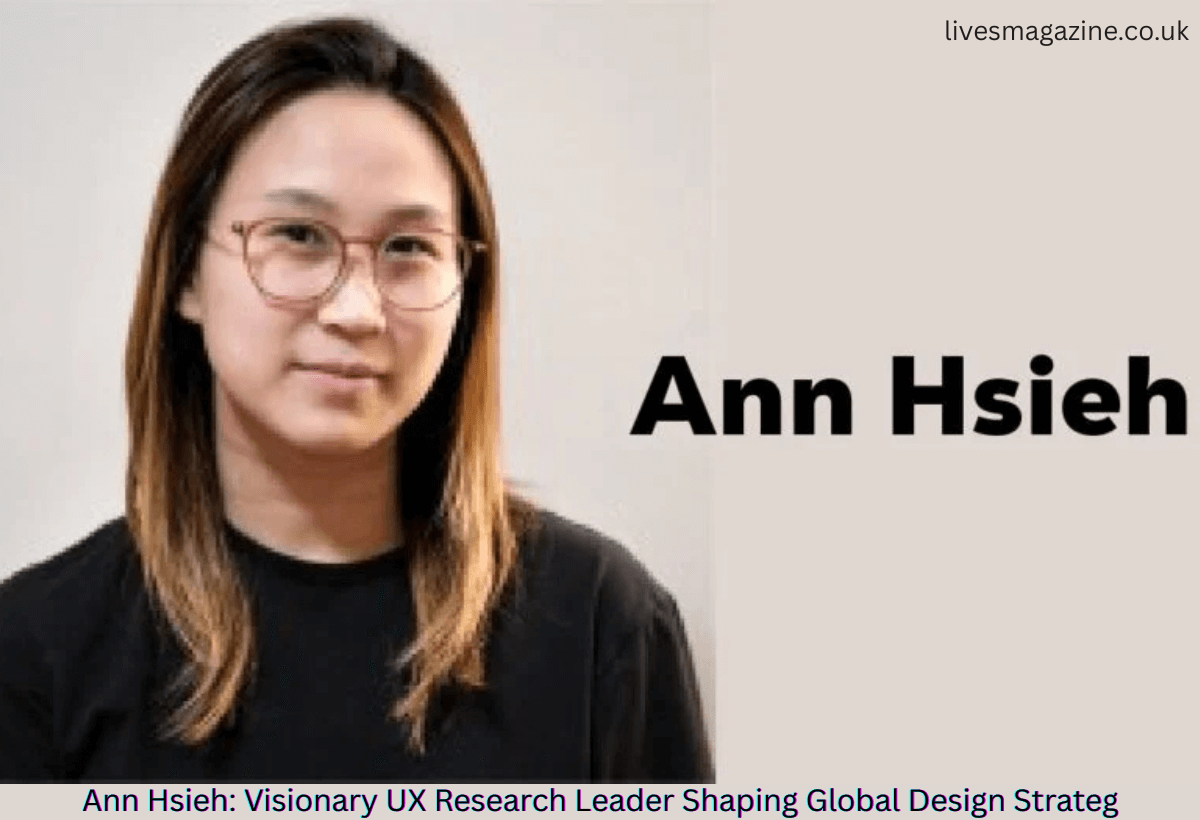
Ann Hsieh is a name that stands out at the crossroads of product strategy, human-centered design, and scalable research operations. Over two decades, she has built and led research teams at global tech companies, translating mixed-methods research into measurable business impact. Her career is a masterclass in how to make user experience research a driver of strategy rather than a support function.
This in-depth profile explores Ann Hsieh’s background, her contributions to UX leadership, her research philosophy, and the lessons she offers to emerging professionals in the field.
Who Is Ann Hsieh? A Global Leader in UX Research
Ann Hsieh is a senior UX research leader recognized for shaping large-scale research operations and aligning them with business outcomes. She has held leadership positions across major technology and e-commerce organizations, where she built frameworks that connect user insights directly to product metrics.
She is often described as a rare blend of scientist and strategist — someone who uses mixed methods rigorously while delivering research outputs that executives can immediately act upon. Ann’s reputation rests not on visibility but on reproducibility: her playbooks, governance systems, and training programs allow organizations to scale insight-driven decision-making effectively.
Academic Foundations: From Cornell to Stanford
Ann Hsieh’s educational foundation bridges psychology, human-computer interaction (HCI), and behavioral science. She holds degrees that emphasize both the analytical and human sides of technology design. This academic grounding is evident in her leadership approach — combining evidence-based methodology with a deep respect for human context.
Her studies shaped two consistent patterns in her work:
- A commitment to methodological rigor — clear hypotheses, mixed-method approaches, and defensible sampling.
- The ability to translate research findings into actionable recommendations that resonate with cross-functional teams.
Early Career: Learning the Ropes at Nokia and Yahoo
Ann’s early professional years were a period of exploration and growth. She began her career in technology firms like Nokia and Yahoo, where she encountered the challenges of designing for global user bases long before UX became a mainstream discipline.
At Nokia, she worked on mobile experiences constrained by early hardware and connectivity limitations. This taught her to be creative, data-driven, and efficient. At Yahoo, she focused on content platforms where engagement, discoverability, and usability were critical. These experiences gave her an understanding of how to balance research quality with speed — a lesson she carries throughout her career.
Meta and Facebook: Driving Community UX at Scale
At Meta (formerly Facebook), Ann Hsieh focused on the dynamics of online communities — one of the most complex aspects of digital experience. Her work centered on understanding how platform design affects creativity, moderation, and healthy interactions among users.
Scaling UX research for communities requires combining quantitative analytics with ethnographic insights. Ann helped design frameworks for measuring community health, ensuring that the product could evolve without compromising on user trust or cultural nuance. Her ability to integrate multiple data streams into a unified story became one of her defining strengths during her time at Meta.
Walmart e-Commerce: Building UX from the Ground Up
Ann’s tenure at Walmart e-commerce was marked by her ability to build UX research systems from scratch. She developed scalable processes, templates, and playbooks that allowed product and design teams to conduct their own studies under a clear governance model.
This democratization of research significantly increased the organization’s learning velocity. Insights could be gathered and implemented faster, leading to measurable improvements in conversion rates, customer satisfaction, and retention.
Her approach demonstrated that even in fast-moving retail environments, user research can directly contribute to business growth when properly structured.
Amazon and Beyond: Leading Global UX Research & Strategy
Ann Hsieh’s leadership at Amazon represents the pinnacle of her operational and strategic capabilities. She directed research initiatives for large-scale seller and customer-facing products, aligning them with business goals such as usability, efficiency, and revenue growth.
One of her key contributions was introducing rapid customer feedback systems to inform design decisions at scale. This system empowered teams to validate hypotheses quickly, reducing time-to-market while improving product quality.
Ann’s philosophy at Amazon emphasized balance — using quantitative data to identify patterns and qualitative insights to explain them. This holistic approach allowed Amazon teams to make decisions backed by evidence while keeping users at the center.
Leadership Philosophy: Empathy, Data & Business Integration
Ann Hsieh’s leadership style is defined by three pillars: empathy, data, and business integration.
Empathy: She believes that research must humanize data. For her, empathy isn’t just about emotion — it’s about understanding users’ real contexts so that design decisions have long-term relevance.
Data-Driven Decisions: Ann integrates multiple research methods — ethnographic field studies, analytics, surveys, and experiments — depending on the question being asked. Her teams prioritize actionable insights over academic perfection.
Business Integration: She sees UX research as a core business function rather than a support role. By linking research outputs to KPIs, she ensures that insights lead to measurable change.
Scaling UX Research in Lean Environments: Frameworks and Playbooks
One of Ann Hsieh’s most significant contributions to UX research is her method for scaling insight across lean teams. Her playbooks and frameworks enable non-researchers — such as designers, PMs, and marketing professionals — to conduct structured studies with oversight from professional researchers.
These playbooks typically include:
- Research request templates that clarify objectives and success metrics.
- Standardized study protocols for usability testing, interviews, and surveys.
- Governance checklists to ensure ethical standards and sample quality.
- Training materials to build confidence among cross-functional peers.
This system reduces dependency on centralized teams while maintaining research integrity. It’s a proven model for organizations that want to scale without sacrificing rigor.
Storytelling Through Data: Turning Insights into Action
Ann is known for her ability to turn complex research into compelling stories that drive change. Instead of overwhelming stakeholders with data, she crafts narratives that connect user pain points to business priorities.
Her teams use concise deliverables — short decks, video clips, and data visualizations — to communicate findings in memorable ways. Each story follows a simple structure:
- Define the problem.
- Present the human and quantitative evidence.
- Recommend the next action.
This storytelling method ensures that research doesn’t just inform but inspires — leading to better products and stronger customer loyalty.
Public Contributions: Keynotes, Awards & Industry Influence
Ann Hsieh’s influence extends beyond her employers. She has participated in professional panels, mentorship programs, and design leadership summits, sharing her experiences in scaling research operations. Her teams have also received recognition within enterprise UX circles for excellence in research-driven design outcomes.
By documenting and sharing her methodologies, Ann helps shape the standards of UX practice across industries, from tech and retail to logistics and education.
Clarifying Identity: Name Confusion, Rumours & Myths
It’s worth noting that “Ann Hsieh” is a common name, and there are multiple professionals worldwide who share it. Some confusion exists online, where achievements or affiliations may occasionally overlap.
The Ann Hsieh featured in this article is recognized for her leadership in UX research, with an extensive background in technology and product strategy. Her work should not be conflated with others in unrelated disciplines.
Lessons for Emerging UX Professionals: What Ann Hsieh Teaches Us
Ann Hsieh’s career offers powerful lessons for anyone in the UX field:
- Blend methodologies. Learn both qualitative and quantitative techniques — each adds a different layer of insight.
- Document and share knowledge. Create repeatable frameworks that others can use.
- Prioritize action. Tie every insight to a tangible outcome or metric.
- Invest in storytelling. Present insights in ways that resonate emotionally and logically.
- Build trust. Strong cross-functional relationships are essential for influence.
- Maintain ethics and governance. Trustworthy research starts with responsible data handling.
By following these principles, UX professionals can evolve from researchers into strategic business partners.
Why Ann Hsieh’s Impact Matters for the Future of UX
The digital world is evolving faster than ever, with AI, global markets, and personalization redefining user expectations. Ann Hsieh’s work represents a roadmap for this future — showing that the combination of empathy, analytics, and operational discipline is key to designing products that truly serve people.
Her scalable research systems are especially relevant in an age when organizations must deliver quick insights without compromising depth or validity. By teaching others how to do good research efficiently, Ann helps ensure that UX remains both credible and impactful.
Practical Advice: Templates & Tools Inspired by Ann Hsieh
For those looking to apply her techniques, here are practical steps:
- Use a research intake form to define the problem, success criteria, and timeline.
- Create concise insight summaries that executives can absorb in minutes.
- Develop training modules for designers and PMs on research best practices.
- Maintain a decision log that tracks how insights influence product updates.
- Focus on feedback loops — measure the impact of research after implementation.
These practices turn UX research into a continuous improvement engine for any organization.
Conclusion: The Ongoing Legacy of Ann Hsieh
Ann Hsieh embodies the evolution of UX research — from isolated projects to strategic business systems. Her combination of academic discipline, real-world pragmatism, and leadership excellence continues to influence how organizations around the world approach design.
Her philosophy is simple yet transformative: do rigorous research, make it actionable, teach others to scale it, and measure the results.
As digital experiences become more complex, leaders like Ann Hsieh remind us that at the core of every great product lies one unshakable truth — understanding people deeply and designing for them intentionally.
Quick FAQ
Q: What is Ann Hsieh known for?
A: Ann Hsieh is known for her expertise in scaling UX research operations and integrating them into business strategy across major global companies.
Q: What is her educational background?
A: Her academic background combines psychology, human-computer interaction, and behavioral science.
Q: What companies has she worked for?
A: Ann has worked with leading technology and e-commerce organizations, including roles at Meta, Walmart e-commerce, and Amazon.
Q: What is her leadership philosophy?
A: She emphasizes empathy, data-driven insight, and the integration of research into business decision-making.
Q: What can UX professionals learn from her?
A: How to operationalize research, communicate insights effectively, and align user understanding with measurable business impact.
Read About:- Dado à