Introduction — What Does “Nativität” Really Mean Today?
“Nativität” is a German word that carries rich, layered meanings: from the Christian “nativity” — the birth of Jesus — to a broader spiritual or astrological idea of natal birth, beginnings, and personal identity. In contemporary discourse the term often appears in two main contexts: religious and cultural narratives celebrating birth and renewal, and astrological or spiritual practices that interpret the exact moment of birth as a blueprint for personality and life direction. This guide brings both approaches together, exploring historical roots, symbolism, cultural practice, and modern interpretations so you can understand: what Nativität meant in the past, what it means now, and why it still matters.
1. Origin of the Term “Nativität” — From Ancient Roots to Modern Use
1.1 Linguistic evolution (Latin → German → modern usage)
The English word “nativity” traces to the Latin nativitas, meaning “birth” or “nativity,” formed from natus — “born.” The German “Nativität” follows this same Latin root and historically is used to describe the birth of Christ as well as the general state or festival of birth. Over centuries, the Latin root traveled through ecclesiastical Latin into the vernacular languages of Europe, keeping both the literal sense (a birth) and the sacred sense (the birth of the divine).
1.2 How different civilizations viewed the idea of “birth” and “creation”
Across ancient cultures birth had cosmological as well as human significance. Babylonian and Mesopotamian scholars recorded celestial events and linked them to earthly outcomes; for them “birth” (of people, kings, or nations) could be read from the sky. In India, early Vedic texts integrated birth with concepts of dharma and life-path; in Mediterranean cultures, myths and rites celebrated the beginnings of gods and heroes, aligning human life-cycles with seasonal rhythms. The idea that a birth moment carries meaning — whether karmic, spiritual, or social — is nearly universal.
1.3 Transition into religious and astrological contexts
As Christianity spread in Europe, the religious event of Christ’s birth — the Nativity — became central to liturgy, art, and public ritual. Simultaneously, astrology — the practice of drawing meaning from the positions of planets and stars at birth — evolved in Hellenistic and later in Islamic and medieval European traditions. Over time the term “nativitas” could point to either the sacred narrative (Christian Nativity) or the astrological record (natal moment), and the German “Nativität” inherits that dual legacy.
2. Nativität in Christianity — The Nativity Story & Its Deep Symbolism
2.1 The birth of Jesus Christ: A brief retelling
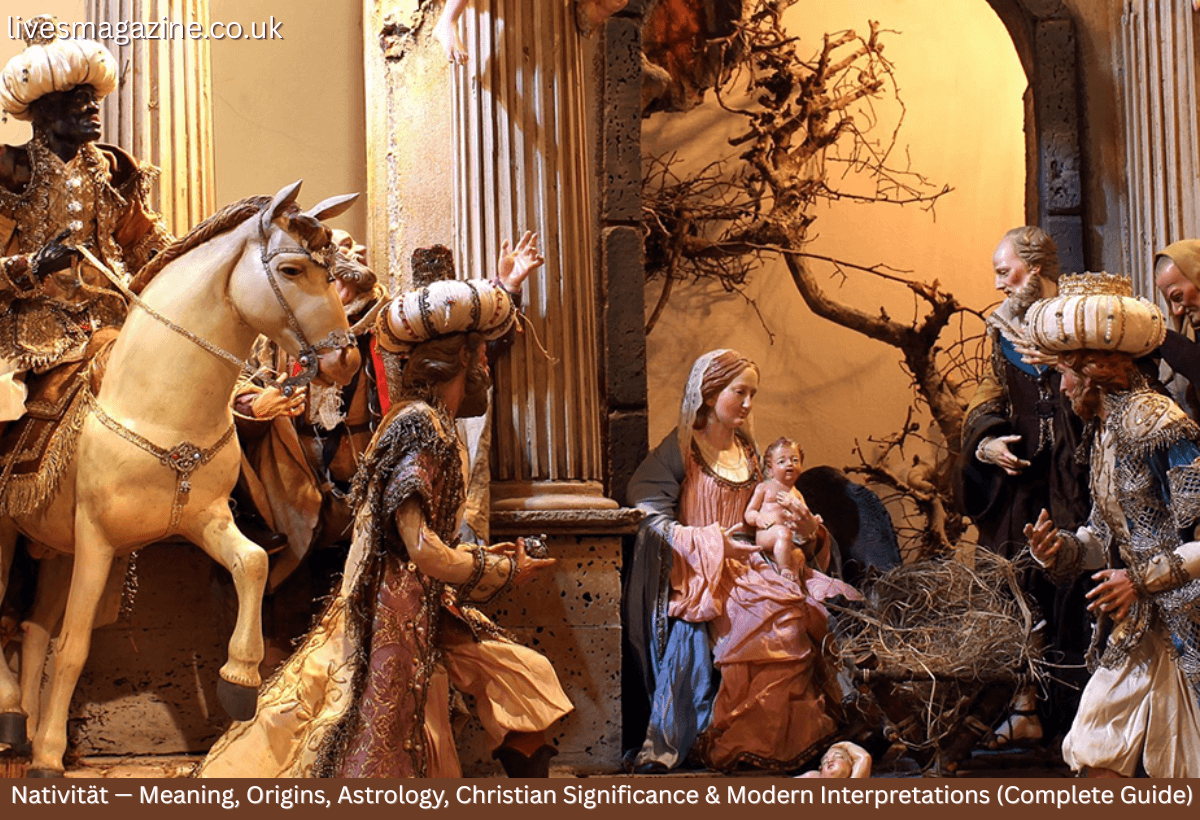
At the heart of Christian theology, the Nativity recounts the birth of Jesus in Bethlehem to Mary and Joseph. The canonical accounts in the Gospels (primarily Matthew and Luke) describe a humble stable or manger, shepherds visited by angels, the Star guiding the Magi, and gifts of gold, frankincense, and myrrh. This simple, human scene symbolizes a transcendent arrival: divine love entering the world in a small, vulnerable form.
2.2 Symbolic Meaning: Hope, divine love, and new beginnings
The Nativity is dense with universally resonant symbolism. It signals hope in the face of hardship, humility as a moral virtue, and the dawn of a new covenant between the divine and humanity. In theological terms, it’s the point at which God enters the human story — a dramatic “beginning” that reshapes moral and spiritual horizons for believers.
2.3 Nativity traditions across the world
Christian communities around the globe commemorate the Nativity in diverse ways: nativity scenes (cribs or crèches), midnight masses, carol singing, and live re-enactments. St. Francis of Assisi popularized staged nativity scenes in the early 13th century to bring the story to life for common folk. From European towns with elaborate crèches to Latin American posadas that dramatize the Holy Family’s search for shelter, practices reflect local culture while preserving the central story.
2.4 How Nativität shaped Christian art, music, and culture
The Nativity inspired centuries of art — from the serene Madonnas of the Renaissance to baroque tableaux and folk carvings. Music, too, bears its imprint: Christmas carols, oratorios like Handel’s Messiah, and modern hymns explore the narrative’s emotional and theological depths. These cultural artifacts keep the Nativity continually reinterpreted and relevant across time.
3. Nativität in Astrology — Birth, Cosmic Influence & Personality Blueprint
3.1 Nativität as the moment of birth in astrology
In astrological practice, the moment of birth — called a natal moment or nativity — is considered an imprint of the sky’s energetic configuration. A natal chart maps planetary placements across zodiac signs and astrological houses at the exact time and place of birth. Practitioners read this map as a symbolic guide to temperament, talents, life challenges, and potential timing for life events.
3.2 Natal chart components (planets, houses, aspects)
A natal chart’s core elements include: planets (representing energies), zodiac signs (qualities through which those energies express), houses (life areas affected), and aspects (angles between planets that shape interaction). For example, the Sun represents core identity; the Moon governs emotions; the Ascendant (rising sign) colors outward behavior. Together these components create a nuanced “portrait” of the individual at birth.
3.3 How Nativität influences personality, destiny, and decisions
Astrologers do not universally claim absolute determinism; rather, many present natal charts as tools for self-understanding and timing. A natal chart can highlight strengths to cultivate, psychological patterns to work through, and windows of opportunity. The idea is not rigid fate but an informed partnership: awareness of natal tendencies can support conscious choices.
3.4 Differences between astrological and religious interpretations
Christian Nativity centers on a theological event and collective salvation narrative; astrological Nativität centers on individualized natal charts and psychological insight. Christian practice often emphasizes ritual, sacrament, and community meanings; astrology emphasizes symbolic language, patterns, and personal growth. Both, however, treat “birth” as a profound threshold marking identity and destiny.
4. Core Symbolism of Nativität — A Universal Theme of New Beginnings
4.1 Light vs darkness
Across spiritual traditions, birth brings light into darkness: a motif of revelation and hope. In Christian iconography, the infant Jesus is often depicted with a halo or bathed in light. In mystic and astrological literature, birth can mark the emergence of conscious life or the soul’s first expression.
4.2 Transformation, rebirth, and spiritual awakening
Nativität implies not only biological birth but also spiritual initiation: renewal, conversion, or the start of a new life chapter. Rituals tied to birth — baptism, naming ceremonies, or seasonal festivals — underscore transformation as both personal and communal.
4.3 Why cultures universally celebrate birth-related events
Birth anchors communities in continuity: lineage, myth, and social order. Celebrating new life affirms hope, preserves cultural memory, and invites generosity. Whether through festivals, rites, or art, societies ritualize birth to express shared values and future orientation.
5. Cultural Perspectives — Nativität Beyond Religion & Astrology
5.1 Nativität in literature, poetry, and philosophy
Writers and poets use nativity themes to explore vulnerability and promise. From religious epics to contemporary essays, the idea of an origin moment frames narratives about identity. Philosophers have also reflected on natality (Hannah Arendt uses the term “natality” to mean human capacity to begin anew), connecting birth with political and ethical agency.
5.2 Depictions in art, film, and modern media
Beyond religious art, nativity motifs appear in cinema, theater, and visual media as metaphors for beginnings — a “birth” of ideas, movements, or personal transformations. Films may transpose Nativity motifs into secular stories about unexpected arrivals or moral awakenings, showing the term’s adaptability.
5.3 How societies celebrate “rebirth” during festivals and ceremonies
Many cultural rituals symbolically reenact birth and renewal: New Year celebrations, spring festivals, harvest rites, and coming-of-age ceremonies. These practices tap the same archetypal meaning of Nativität: continuity, regeneration, and community affirmation.
6. Modern Interpretations — How People Use “Nativität” Today
6.1 Personal growth and self-renewal
In contemporary wellness and spiritual circles, Nativität is often reinterpreted as inner rebirth — an awakening or transformation that can happen at any life stage. Coaching, therapy, and spiritual direction sometimes use natal metaphors to frame new beginnings, career shifts, or relationship pivots.
6.2 Psychological meaning: reinventing yourself
Psychology recognizes that people periodically reconstruct identity — often after crises, losses, or major life events. The “natal” metaphor helps describe these reinventions as opportunities to reclaim agency and reimagine purpose.
6.3 Use of Nativität in meditation, therapy, and holistic healing
Meditative practices may invoke nativity as a point of intention: setting a new intention on your birthday, during new moons, or at personal retreats. Holistic therapies combine ritual, reflective journaling, and symbolic acts to mark transitions as meaningful, healing experiences.
6.4 Digital age interpretations (e.g., New Year, life milestones)
In the age of social media, “birth” can extend to digital births — the launch of a company, the debut of a project, or an online persona’s “coming out.” Marking milestones with narrative and ritual remains central, and Nativität-language can help frame these moments as beginnings that deserve ritual recognition.
7. Comparison: Christian vs Astrological Meaning of Nativität
7.1 Key similarities
Both Christian and astrological readings treat birth as a threshold of meaning. Each tradition values origin stories for how they shape identity and communal memory. Both can inspire ritual, art, and reflection.
7.2 Major differences
Christian Nativität is theological and communal; it centers on an historical-religious event with universal theological implications. Astrological Nativität is interpretive and individual; it maps unique natal configurations for personal insight. Theology focuses on salvation and moral teaching; astrology focuses on symbolic psychology and timing.
7.3 Why both matter in modern culture
The coexistence of both meanings reflects modern pluralism. People draw from religious narrative for communal values and from astrology for personal guidance — sometimes blending both into individualized spiritual practices. This hybrid approach mirrors how contemporary identities are layered and multifunctional.
8. Why Nativität Still Matters — Lessons for Today’s World
8.1 Inspiration
Nativität inspires creative and moral imagination: the Nativity story calls people to compassion, while natal astrology invites deeper self-reflection.
8.2 Faith
For many, Nativität remains a foundation of faith and ritual continuity; the Nativity narrative anchors liturgical life and communal observance.
8.3 Identity
Whether religious or astrological, Nativität helps people narrate their origins and situate personal identity within a larger story.
8.4 Reflection
In a fast-paced world, Nativität encourages pauses for reflection — to mark growth, mourn losses, and make commitments anew.
9. Practical Ways to Engage with Nativität Today
9.1 Explore your natal chart or birth story
If you’re curious about astrological Nativität, seek a reputable astrologer or use reliable chart tools (with accurate birth time and place) as a starting point. If you’re approaching Nativität from faith, read traditional texts or community retellings to deepen understanding.
9.2 Create personal rituals for new beginnings
Design simple rituals: journaling on your birthday, lighting a candle at the start of a new project, or staging a small ceremony with friends to mark transitions.
9.3 Use art and storytelling
Make or collect art that expresses newness — write a short personal “origin” story, create a visual nativity, or compose music that marks your next chapter.
9.4 Community engagement and learning
Join discussion groups, faith communities, or astrology circles where you can compare perspectives and learn how others interpret Nativität.
10. Frequently Asked Questions (FAQs)
Q1. What is the true meaning of Nativität?
Nativität literally means “birth” and is used both to denote the Christian nativity (the birth of Jesus) and the astrological natal moment that charts a person’s cosmic blueprint. Its “true” meaning depends on context: theological in religious contexts, symbolic/psychological in astrological ones.
Q2. Is Nativität only a Christian term?
No. While strongly associated with Christian tradition, especially in Europe, the term’s Latin roots and conceptual range allow it to refer to natal birth in a broader spiritual or secular sense.
Q3. What is the difference between Nativität and Nativity?
They are essentially the same concept in different languages: “Nativity” is English; “Nativität” is German. Both reference the concept of birth, often used in religious contexts (the Nativity of Christ) and in broader natal interpretations.
Q4. How is Nativität used in astrology?
Astrologers use the natal moment — the exact date, time, and place of birth — to construct a natal chart. This chart is read symbolically to gain insight into personality tendencies, life themes, and timing for important events.
Q5. Why is Nativität still celebrated globally?
Because birth and beginnings are universal human experiences tied to hope, continuity, and cultural identity. Whether via religious ceremonies, seasonal festivals, or personal rituals, cultures mark new beginnings to reinforce communal bonds and moral values.
11. Conclusion — The Enduring Power of Nativität
Nativität unites two powerful human tendencies: the need to understand origins and the desire to ritualize transformation. Whether you approach the term from the hushed holiness of a nativity scene or the charted sky of a natal horoscope, both uses affirm birth as a portal of meaning. In our plural and rapidly changing world, Nativität remains useful: as a theological story that invites compassion, as an astrological tool for self-knowledge, and as a broader cultural metaphor that helps us mark, honor, and learn from our beginnings. Reflecting on Nativität — in personal ritual, communal celebration, or quiet contemplation — invites a timeless lesson: every beginning holds the possibility of light, renewal, and renewed purpose.
Read About:- Shelly D’Valle