Introduction — Why the Smartphone Era Is Ending
Smartphones changed everything: how we work, socialize, shop and learn. But they are also reaching natural limits. Incremental improvements to screens, cameras and chips yield diminishing returns; social expectations and use-patterns are evolving toward more seamless, less screen-bound interactions. Big technology companies are betting that the next major platform shift will replace — or at least significantly reduce — our dependence on handheld rectangles. That shift centres on spatial computing (AR/XR), ambient AI, wearable ecosystems and brain-computer interfaces (BCIs). These technologies promise hands-free, context-aware experiences that blend digital capabilities into the physical world, and they are already commanding massive R&D budgets and strategic pivots across Silicon Valley and beyond.
In short: we are moving from “look-at-this-screen” computing to “the world is the interface.” The companies building that world are making moves now — not just to sell gadgets, but to establish the ecosystems, standards and data flows that will define computing for the next decade.
What Comes After Smartphones? The Next Computing Interface
Definition: Post-Smartphone Era
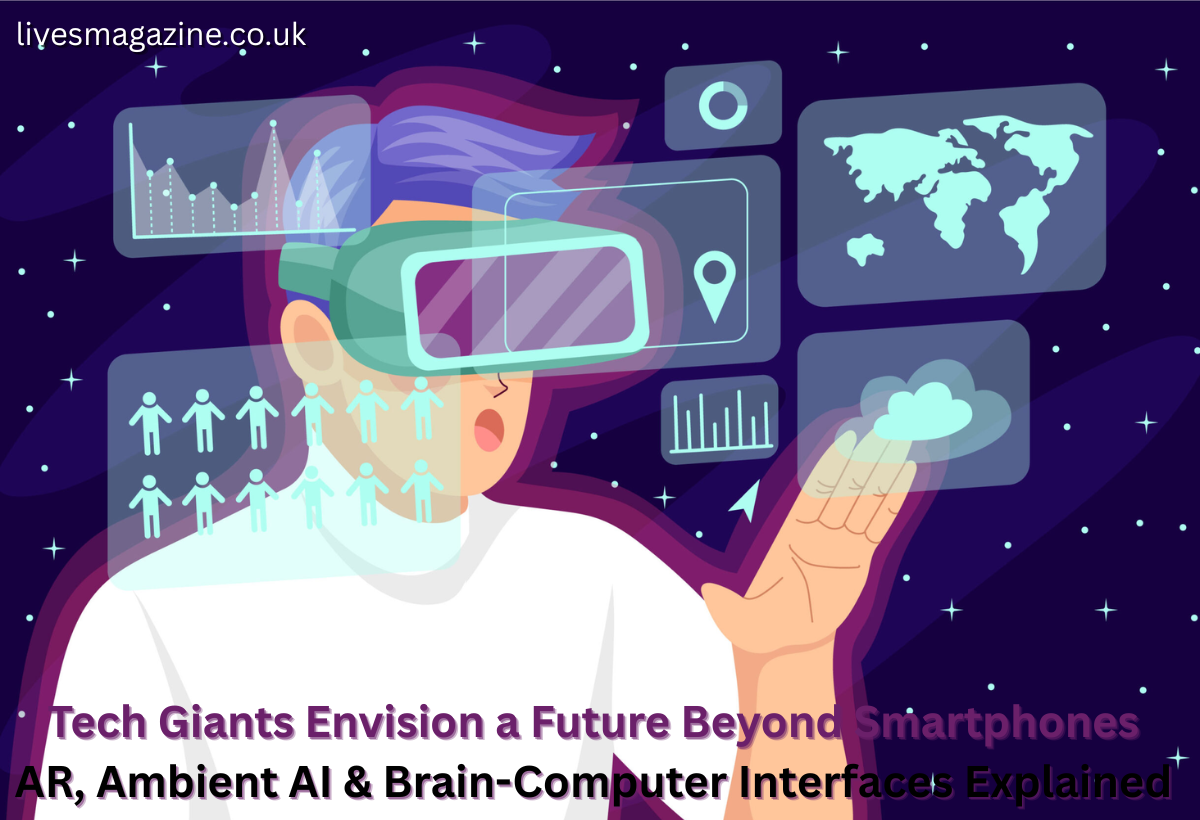
“Beyond smartphones” refers to a computing era where the smartphone is no longer the primary gateway for most digital interactions. Instead, computing surfaces are distributed — embedded in glasses, earbuds, rings, clothing, physical spaces and, eventually, direct neural links. Instead of reaching for a device, users interact through gestures, voice, glance, spatial UI and contextual prompts from ambient AI agents.
Spatial Computing Explained
Spatial computing is the class of technologies that understand and augment physical space — placing digital objects and interfaces within the 3D world and letting people interact with them naturally. Think AR glasses overlaying instructions on a machine part, or a virtual whiteboard that appears in your living room for a remote team meeting. Spatial computing changes design priorities: geometry, persistence, ergonomics and social acceptability become as important as pixels and frame rates.
The Technologies Replacing Smartphones
Augmented Reality Glasses
AR glasses aim to put a contextual display in your field of view — delivering notifications, navigation cues, translation overlays and collaboration tools without requiring you to pick up a phone. Hardware has evolved from clunky prototypes to sleeker designs with increasing processing power, though battery life, optics and heat remain engineering challenges. Market forecasts expect rapid growth from a small base: smart glasses shipments and revenue are projected to scale substantially through 2030 as form factors improve and developer ecosystems mature.
Brain-Computer Interfaces (BCIs)
BCIs translate neural signals into commands. Initially developed for medical use (e.g., enabling people with paralysis to control cursors or prosthetics), companies like Neuralink are advancing both implantable and non-invasive systems that could one day support thought-based device control or assistive augmentation. Clinical trials and safety data are critical early steps; broad consumer adoption remains years away and will demand major regulatory and ethical safeguards.
Ambient AI and Invisible Computing
Ambient AI refers to systems that learn from context and act proactively — offering suggestions, automating routine tasks and surfacing the right information at the right moment. Instead of searching or tapping, users receive contextual assistance that anticipates needs (calendar nudges, route shortcuts, or health reminders). Ambient AI relies on sensor fusion (location, audio, biometric) and distributed compute (edge/cloud) to reduce latency and protect privacy through local processing.
Holographic Displays & XR
Holographic and extended reality (XR) displays enable immersive experiences where digital content integrates seamlessly with the environment. XR spans the spectrum from mostly real (AR) to mostly virtual (VR), and the most commercially useful early applications are hybrid: training, remote assistance, collaborative design and therapy.
Wearable Ecosystem
The new interface is a network of devices working together: smartwatches, earbuds, smart rings, AR glasses and in-home sensors. Rather than one device doing everything, capabilities are distributed — making interactions lighter (short voice queries through earbuds, glanceable info via glasses) and more resilient (failover between devices).
Inside the $3 Trillion Race to Replace the Smartphone
Market Size & Revenue Forecast
Analysts and industry reports forecast that the post-smartphone ecosystem — including AR hardware, wearable services, ambient AI platforms and associated software — could become a multi-billion to multi-trillion dollar opportunity by the early 2030s. Projections vary by scope (hardware only vs. hardware + services), but widely cited research expects exponential growth as unit shipments and software monetization scale. For example, smart AR glasses shipments are projected to rise from under a million units today to the low-tens of millions by 2030, supporting a multibillion-dollar market.
Adoption Timeline
- Phase 1 (2024–2028): Enterprise-first and early adopter consumer use. Headsets and XR systems find traction in healthcare, manufacturing and remote collaboration.
- Phase 2 (2028–2032): Consumer wearables (AR glasses, advanced earbuds, mixed reality devices) mature in comfort and battery life; ambient AI becomes more capable and trusted.
- Phase 3 (2032+): Broader mainstream adoption if cost, form factor and social acceptance align; neural interfaces may begin limited commercial use in niche applications.
These timelines are not fixed; they depend on breakthroughs in optics, power efficiency, AI capabilities and public trust.
How Major Tech Giants Envision the Future
Apple — Vision Pro to AR Contact Lenses
Apple’s approach emphasises design, integration and premium experiences. With devices that prioritize user comfort and seamless interoperability with existing iPhones, iPads and Macs, Apple positions spatial computing as an extension of its ecosystem. The Vision Pro headset launched a visible spatial computing product, but Apple’s long game likely centers on smaller, more wearable AR devices that fit into daily life while leveraging Apple’s tight hardware-software integration.
(Recent reporting has shown Apple recalibrating production plans for Vision Pro amid early sales and inventory decisions, underscoring the difficulty of moving from niche headset to mass consumer product.)
Google — Ambient AI Everywhere
Google’s strength is systems and scale: mapping, search, cloud and Android. Google’s investments in AR frameworks, Android XR and edge AI are designed to enable developers and OEMs to build spatial experiences that integrate with large language models and location services. The strategic objective: fold ambient intelligence into the operating fabric of daily life so contextual help and on-the-fly translation become ubiquitous.
Meta — Reality Labs & Social Spatial Worlds
Meta invested heavily in Reality Labs to build both hardware (Quest VR, Ray-Ban smart glasses partnerships) and social platforms (Horizon Worlds). While Reality Labs has incurred large losses, Meta continues to iterate on wearables and social spatial experiences, shifting allocations to wearable glasses and AI-driven features as it seeks tighter product-market fit. The scale of Meta’s investment demonstrates how important it thinks owning the next interface will be — even if profitability remains an open question.
Microsoft — Enterprise XR & Neural Interfaces
Microsoft’s priority is enterprise: the HoloLens and Microsoft Mesh aim to transform training, remote assistance and design collaboration in industry. Azure’s cloud and edge capabilities, plus integration with Microsoft 365, make Microsoft a strong bet for businesses that need secure, scalable spatial tools. Microsoft’s focus illustrates that the post-smartphone shift will likely be a hybrid path — enterprise adoption paving the way for consumer normalization.
OpenAI — Voice-First AI Agents
OpenAI and other leading AI labs are advancing ambient intelligence through conversational agents and multimodal models. The ambition: agents that understand context, manage tasks, and communicate naturally across devices. Rather than inventing new hardware, AI companies can reshape the interface by enabling language as a universal, device-agnostic input method.
Neuralink — Brain Interface Revolution
Neuralink represents the frontier: direct neural interfaces with the potential to translate intention to action without intermediate physical gestures. The company’s PRIME study and early devices (e.g., the N1 implant) are focused on clinical performance, safety and signal fidelity. While promising for assistive technologies, consumer neuro-augmentation faces not only technical hurdles but profound ethical and regulatory challenges.
Patents, Investments & Breakthrough Research
Biggest R&D Projects
Big tech is funding projects across optics, low-power compute, computer vision, spatial audio, neural decoding, and privacy-preserving on-device AI. Some well-known investments include Reality Labs (Meta), Apple’s spatial computing teams, Google’s AR toolkits and Microsoft’s mixed-reality enterprise stack. These programs combine internal R&D with acquisitions and university partnerships.
Patent Landscape
Ownership of core patents in optics, AR projection, sensor fusion and human-computer neural translation will influence who can build interoperable ecosystems. Companies file patents not only to protect inventions but to secure bargaining positions for platforms and standards. Monitoring patent filings gives insight into long-term strategic bets.
Research Partnerships
Collaboration between companies and universities accelerates foundational discoveries (e.g., new low-power displays, neural decoding algorithms, and privacy-preserving sensor processing). Multi-disciplinary research groups — blending optics, AI, neuroscience and design — are particularly critical for turning labs into products.
Why Phones Can’t Support the Next Computing Wave
Limitations of Phones
Smartphones are optimized for handheld, touch-based interactions. They have limited field of view, demand visual focus, and aren’t ideally suited for hands-free or glanceable experiences. Battery and thermal constraints limit continuous, always-on sensing and high-fidelity spatial rendering that AR glasses or spatial compute devices require.
Natural Interfaces
Natural interfaces (speech, glance, gesture, neural intent) are more congruent with human behaviour in many contexts: driving, manufacturing, caregiving and physically collaborative tasks. When interfaces are natural, tasks can be performed more safely, efficiently and with reduced cognitive load.
Challenges Blocking Mass Adoption
Privacy & Surveillance Fears
Always-on sensors and context-aware systems invite legitimate privacy concerns. Wearables with cameras, spatial microphones or biometric sensors could collect sensitive personal data. Building trust requires privacy-first architectures (on-device processing, minimal retention policies, transparent consent) and robust regulation. Interviewers, regulators and consumers alike expect concrete privacy guardrails as part of any post-smartphone proposal.
Cost & Accessibility
Early spatial devices are expensive. Enterprise customers often absorb costs for productivity gains, but consumer adoption requires affordable, stylish hardware. Cost curves must fall dramatically for AR glasses to be as common as sunglasses.
Social Acceptance
Wearing visible headsets or glasses has social friction: stigma, etiquette and aesthetic concerns. The history of wearable tech shows that products need both usefulness and social acceptability to thrive.
Health & Safety
Animation sickness, ocular strain, and the long-term effects of neural implants are real considerations. Regulatory bodies and independent researchers will scrutinize hardware for safety and establish usage guidelines.
How Life Will Look Beyond Smartphones
What Replaces Apps
Instead of app islands, expect conversational agents and contextual surfaces. “Apps” will be modular services invoked by voice or glance — a design that favors composability and intent routing over full-screen interaction.
Communication & Work
Spatial collaboration enables teammates to “stand around” a 3D model from different locations, pin persistent virtual notes in physical spaces, and use gestures to manipulate shared objects. Remote work gains a new form of presence, where spatial cues and audio help maintain context and attention.
Entertainment & Gaming
Immersion expands: games blend with rooms, live events project holograms into living rooms, and mixed reality social spaces create new forms of shared experience. Monetization shifts from single purchases to subscriptions, location-based experiences and in-world commerce.
Education & Healthcare
Hands-on learning becomes richer with step-by-step AR overlays. In healthcare, spatial guidance reduces surgical errors and BCIs help restore function to patients with paralysis. Telepresence becomes more effective when the remote participant can interact with real objects through augmented overlays.
What Jobs and Skills Are Needed for the Post-Smartphone Era
New Job Roles
- Neural UX Designers: craft interfaces that translate cognitive states into meaningful outcomes.
- Spatial Engineers: build persistent, multi-user, location-aware experiences.
- Privacy & Trust Engineers: specialize in on-device ML, differential privacy and consent frameworks.
- Bio-data Analysts & Ethics Officers: bridge neuroscience data with regulation and clinical safety.
- Physical-Digital Product Managers: coordinate hardware, firmware and cloud services.
Skills You Should Learn Now
- Mixed reality development (Unity, Unreal, WebXR)
- Multimodal AI (vision + language + audio)
- Mobile & edge ML optimization (TensorFlow Lite, Core ML)
- Privacy engineering and secure data architectures
- Human factors and ergonomics for wearables
These skills position professionals for roles that will grow as devices move from labs into real workflows.
Will Smartphones Disappear Completely? A Realistic Outlook
Smartphones are unlikely to vanish overnight. Instead, expect a multi-device future: phones will coexist with glasses, earbuds and other wearables — much like laptops coexist with phones today. In many regions and demographics, phones will remain primary for years because of cost, network dependency and cultural adoption patterns. The transition will be gradual and uneven: enterprise sectors often lead, consumer mass adoption follows, and regulatory frameworks adapt over time.
Conclusion — The Beginning of a Screenless World
Tech giants are placing big, strategic bets that computing will become less about singular devices and more about persistent, context-aware experiences layered over the physical world. Whether through AR glasses, ambient AI agents or neural interfaces, the future interface will be more human-centric and less screen-bound. The path is complex: it requires breakthroughs in hardware, software and trust frameworks, along with realistic business models. But the prize is enormous — a redefinition of how we work, learn and communicate.
If you’re a product manager, engineer, designer or strategist, now is the moment to master spatial thinking, multimodal AI and privacy-first architectures. The companies that can combine technical excellence with humane, ethical design will lead the next platform era.
FAQs
Q: What is meant by “future beyond smartphones”?
A: It describes a shift from smartphones as the main interface to a world where devices, ambient intelligence and potentially direct neural links provide context-aware, hands-free interaction.
Q: Will AR glasses replace smartphones?
A: Not immediately. AR glasses will complement phones, likely seeding in enterprise uses and early adopter consumers before becoming mainstream — if they reach acceptable cost, comfort and social norms. Market projections show smart glasses scaling from hundreds of thousands of units today to low-tens of millions by 2030.
Q: Which companies are leading the post-smartphone race?
A: Apple, Google, Meta, Microsoft, OpenAI and a group of neuroscience startups (e.g., Neuralink) are prominent players. They pursue different strategies — consumer hardware, enterprise platforms, or foundational AI models.
Q: Are brain-computer interfaces ready for consumers?
A: BCIs are advancing quickly in clinical settings, but consumer-grade neural augmentation faces technical, ethical and regulatory hurdles. Clinical trials (e.g., early N1 implant studies) are in progress, but mass consumer use remains years away.
Q: What is ambient AI?
A: Ambient AI embeds intelligence into the environment so systems proactively help users by anticipating needs and acting with minimal explicit input. It combines sensor data, on-device models and cloud services to deliver contextual assistance.
Read More:- SnowMTL