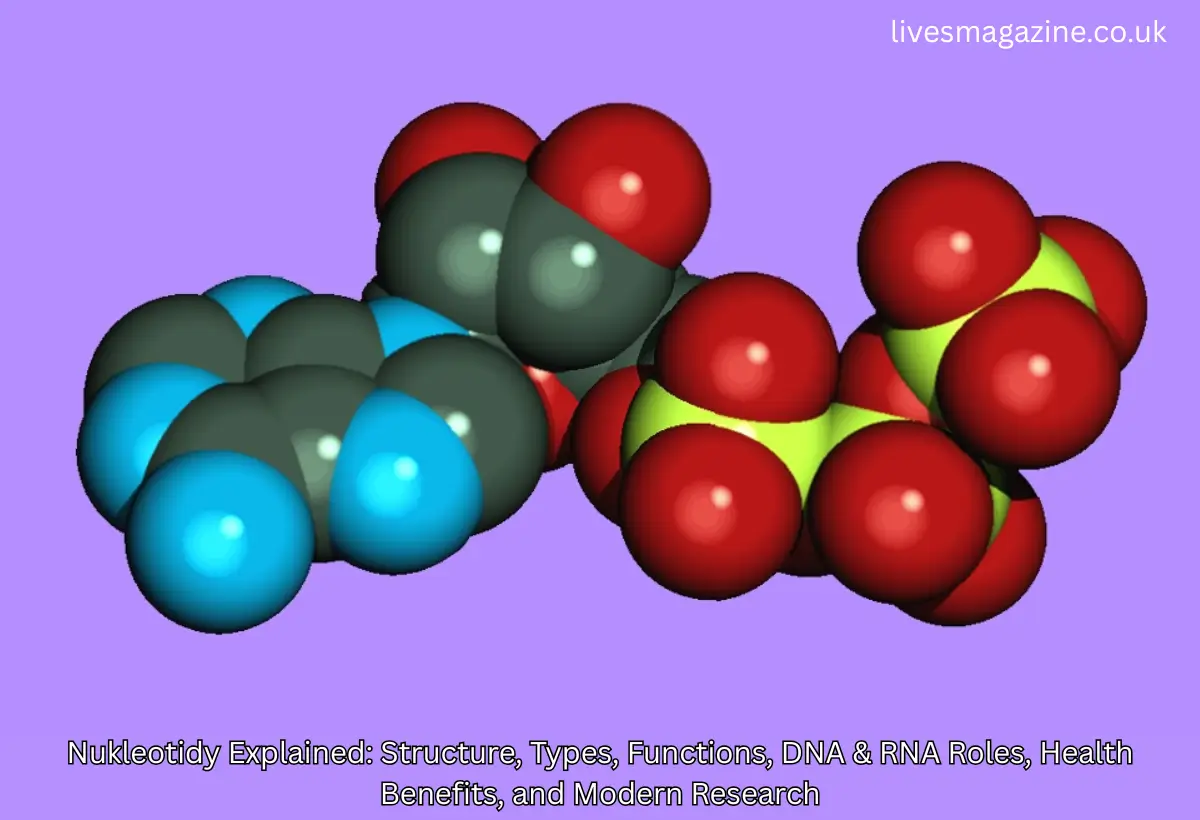
Introduction to Nukleotidy
At the most fundamental level, a nucleotide is an organic molecule consisting of three core components: a nitrogenous base, a five-carbon sugar, and one or more phosphate groups.
They serve as the monomeric units — or subcomponents — of nucleic acids like DNA and RNA, meaning that these larger structures are built by linking many nucleotides together. But beyond genetics, nucleotides also play central roles in energy production, signaling, and biochemical regulation.
What Are Nukleotidy? (Scientific Definition)
A nucleotide combines a nitrogen-containing base, a pentose sugar (ribose or deoxyribose), and a phosphate group to form a single unit.
- Nitrogenous base: A chemical ring structure essential for storing information.
- Pentose sugar: Determines whether the nucleotide is part of DNA (deoxyribose) or RNA (ribose).
- Phosphate group(s): Allow linkage between nucleotides, forming long DNA or RNA chains.
Together, these units create polynucleotide strands that carry the genetic blueprint of every living cell.
Difference Between Nukleotidy and Nucleosides
A related term is nucleoside, which includes only the base and sugar — without any phosphate. Adding a phosphate transforms a nucleoside into a nucleotide, enabling it to participate in structural and metabolic activities.
Chemical Structure of Nukleotidy
Understanding the structure of a nucleotide explains how it performs so many functions.
Phosphate Group
Nucleotides can have 1 to 3 phosphate groups — from monophosphate (e.g., AMP) to triphosphate (e.g., ATP). The high-energy bonds between phosphates — especially in triphosphates — are key to energy storage and transfer.
Pentose Sugar (Ribose vs Deoxyribose)
The sugar component differentiates DNA from RNA:
- Deoxyribose (in DNA): lacks one oxygen atom, giving DNA structural stability.
- Ribose (in RNA): contains an –OH group, enabling RNA’s varied functions.
Nitrogenous Bases
There are five core bases:
- Purines: Adenine (A) and Guanine (G)
- Pyrimidines: Cytosine (C), Thymine (T), and Uracil (U)
In DNA, thymine is used; in RNA, uracil replaces thymine.
Types of Nukleotidy
Biologically, nucleotides are grouped based on their nitrogenous bases:
Purine Nukleotidy
- Adenine (A)
- Guanine (G)
These consist of a double-ring molecular structure.
Pyrimidine Nukleotidy
- Cytosine (C)
- Thymine (T)
- Uracil (U)
These have a smaller single-ring structure.
Each type participates in specific base-pairing patterns that drive DNA replication and RNA transcription.
Base Pairing Rules and Genetic Accuracy
Within double-stranded DNA, nucleotides pair via hydrogen bonds:
- Adenine (A) ↔ Thymine (T)
- Cytosine (C) ↔ Guanine (G)
In RNA, uracil (U) replaces thymine.
This complementary base-pairing ensures accurate copying of genetic information during DNA replication and correct translation during RNA synthesis — the basis for stable inheritance and protein production.
Role of Nukleotidy in DNA
DNA (deoxyribonucleic acid) is a double helix composed of long chains of nucleotides connected by phosphodiester bonds between sugar and phosphate groups.
Each gene is a section of DNA that encodes instructions for building a protein. As cells divide, DNA replicates, ensuring genetic information passes precisely from one cell generation to the next.
Role of Nukleotidy in RNA
RNA (ribonucleic acid) is usually a single-stranded molecule made of nucleotide sequences that help turn DNA instructions into functional proteins.
Messenger RNA (mRNA)
Carries coded messages from DNA to ribosomes — the cellular machines that build proteins.
Transfer RNA (tRNA)
Delivers specific amino acids to growing protein chains during translation.
Ribosomal RNA (rRNA)
A central structural and catalytic component of ribosomes.
Biological Functions of Nukleotidy in Cells
Nukleotidy are not just structural molecules — they also power biochemical life.
Protein Synthesis
Genetic information encoded in DNA is processed into proteins via mRNA, tRNA, and rRNA — all built from nucleotide chains.
Enzyme Regulation and Signaling
Cyclic nucleotides like cAMP and cGMP act as second messengers — chemical signals inside cells that amplify and regulate responses to hormones and environmental cues.
Energy Role of Nukleotidy
Perhaps the most famous nucleotide is ATP (adenosine triphosphate), which functions as the cell’s primary energy currency.
ATP — The Energy Currency of Life
ATP consists of adenine, ribose, and three phosphate groups. When the bonds between these phosphates are broken, a tremendous amount of energy is released to drive biological reactions like:
- Active transport across cell membranes
- Protein synthesis
- Muscle contraction
Remarkably, the human body recycles and uses about 200–300 moles of ATP daily — illustrating how vital these molecules are to life.
Other Energy-Related Nukleotidy
- GTP (guanosine triphosphate): crucial for protein synthesis and signal transduction.
- CTP and UTP: involved in lipid and carbohydrate synthesis.
Nukleotidy in Cellular Signaling
Beyond energy, nucleotides act in signaling pathways:
- cAMP (cyclic adenosine monophosphate) helps cells respond to hormones and regulate metabolism.
- cGMP (cyclic guanosine monophosphate) plays roles in vision and blood vessel dilation.
These molecules transmit messages inside cells that activate or inhibit biological pathways essential for growth and adaptation.
Metabolism and Synthesis of Nukleotidy
Cells maintain balance between making new nucleotides and recycling old ones.
De Novo Synthesis
This pathway builds nucleotides from basic building blocks like amino acids, ribose-5-phosphate, and carbon dioxide.
Salvage Pathway
When nucleotides break down, they can be recycled efficiently through the salvage pathway, conserving energy and resources.
Nucleotide Degradation and Uric Acid
In humans, degradation of purine nucleotides produces uric acid, which is excreted in urine. Excessive uric acid accumulation can cause gout, a painful joint condition.
Nukleotidy and Human Health
Balanced nucleotide metabolism is essential for growth, immunity, and tissue repair.
Immune System Support
During stress, infection, or growth, cells such as immune cells divide rapidly and require large amounts of nucleotides — making them crucial for effective immune function.
Gut Health and Tissue Repair
Some studies suggest dietary nucleotides may benefit gut development and support the integrity of intestinal lining, especially in infants.
Dietary Sources of Nukleotidy
Although the body can synthesize nucleotides, dietary intake can help, especially during high demand. Foods rich in nucleotides include:
- Meat and fish
- Legumes
- Fermented products
In infant formula, added nucleotides have been shown to support immunity and intestinal development, reflecting their nutritional importance.
Nucleotide Supplementation
Nucleotide supplements are sometimes used in clinical nutrition to support recovery, immune health, and gut integrity. However, quality, dosage, and scientific backing are essential for safety and effectiveness.
Medical and Biotechnological Applications
Nukleotidy are invaluable in many modern scientific and medical technologies:
- PCR and DNA sequencing rely on synthetic nucleotides to amplify and read genetic information.
- Antiviral drugs often mimic natural nucleotides to disrupt viral replication.
- Gene editing technologies like CRISPR depend on precise nucleotide targeting to correct genetic defects.
These applications show how understanding nucleotides drives innovation in diagnostics, treatments, and biotechnology.
Role of Nukleotidy in Evolution
Mutations — changes in nucleotide sequences — are the basis of genetic variation. Some mutations are harmful, but others provide advantages that contribute to natural selection and adaptation.
By comparing nucleotide sequences across species, scientists can trace evolutionary history and biological relationships, helping to map the tree of life.
Environmental and Ecological Applications
Nucleotide research also extends to environmental science:
- DNA barcoding uses unique nucleotide patterns to identify species, monitor biodiversity, and detect changes in ecosystems.
- Environmental DNA (eDNA) techniques help assess pollution impacts and track species presence without capturing organisms directly. These tools are transforming conservation biology and ecological monitoring.
Future of Nukleotidy Research
Cutting-edge areas of nucleotide research include:
- Synthetic biology: Designing custom DNA sequences and artificial nucleotides for new functions.
- DNA-based data storage: Using nucleotide chains as ultra-dense memory systems.
- Nanotechnology: Creating molecular machines powered by nucleotide interactions.
Advances in genomics and molecular engineering continue to reveal deeper roles for nucleotides in biology and technology.
Frequently Asked Questions About Nukleotidy (FAQ)
Q: What is the difference between a nucleotide and a nucleoside?
A: A nucleoside contains only a base and sugar, while a nucleotide also includes a phosphate group, enabling it to function in metabolism and structure.
Q: Are nucleotides essential in the diet?
A: The body produces nucleotides, but dietary intake can support health during growth, stress, or illness, especially in infants.
Q: Why are nucleotides important for immunity?
A: They support rapid cell division required for effective immune responses and tissue repair.
Q: Do nucleotides provide energy?
A: Yes — ATP and other triphosphates store and transfer energy for cellular reactions.
Q: Are nucleotides only related to genetics?
A: No — they also play roles in metabolism, signaling, and cellular regulation.
Conclusion
Nukleotidy may be tiny, but their impact on life is gigantic. From encoding genetic information to powering every biochemical reaction, these molecules are at the heart of biology. Understanding how nucleotides work not only reveals the mechanics of life but also opens doors to medical advances, biotechnology, and solutions for human health and environmental challenges.
Whether in the nucleus of a cell or the development of cutting-edge biotechnology, the story of life — at every scale — is written in the language of nukleotidy.
Read More: Anoboy