What Is Lender Processing?
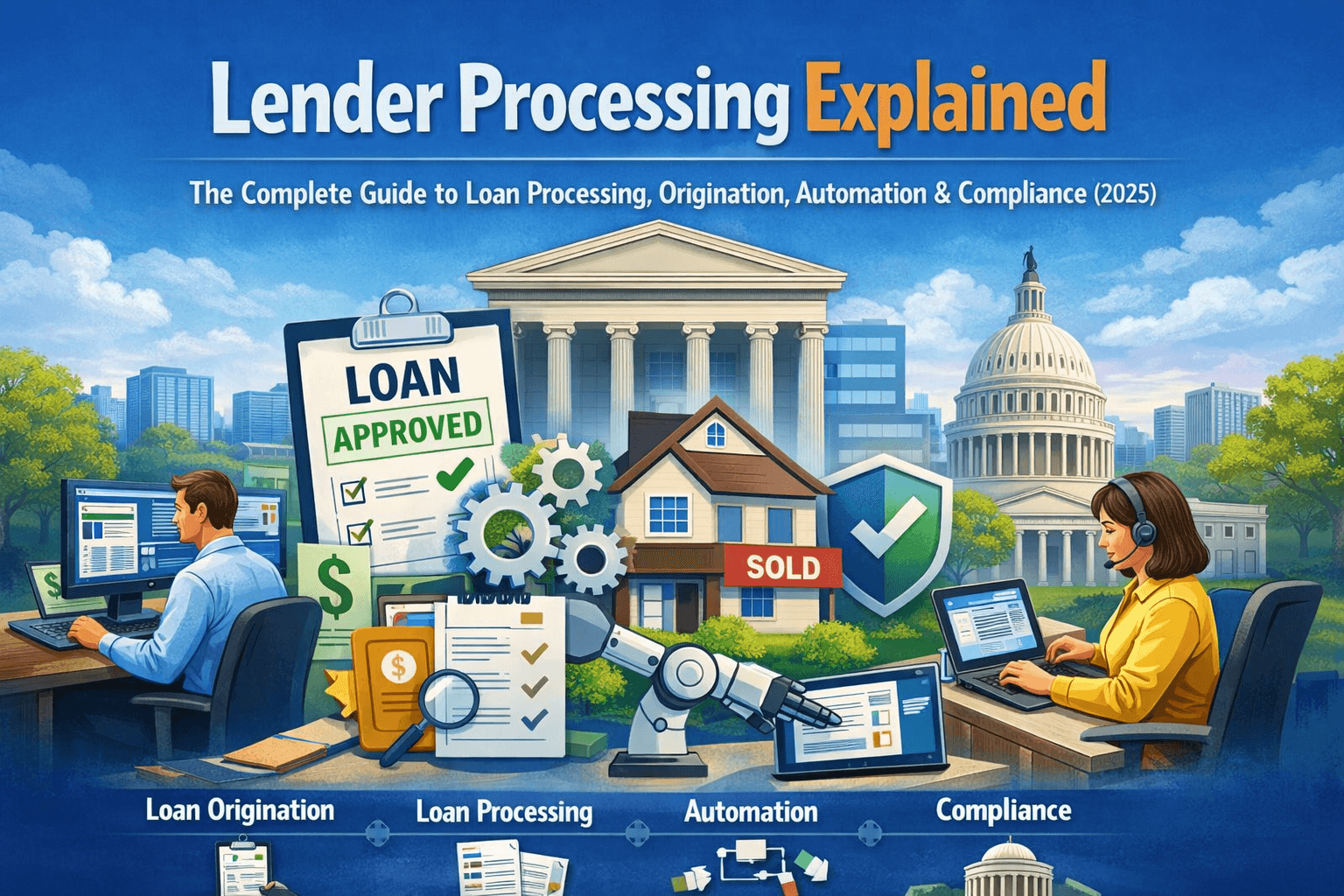
Lender processing is the operational workflow lenders use to review, verify, underwrite, approve (or decline), document, and fund a loan. It covers all steps between a submitted application and the disbursement of funds — and often overlaps with origination (front-end intake and pricing) and servicing (post-funding administration). A complete definition emphasizes people (loan officers, processors, underwriters), systems (LOS, credit bureaus, payment rails), and rules (compliance, underwriting policy).
Lender processing is less about a single task and more about a coordinated sequence of decisions, checks, and communications that must be fast, accurate, auditable, and secure.
Lender Processing vs Loan Origination vs Loan Servicing
Understanding the differences avoids confusion and helps allocate responsibilities and technology investments.
What Is Loan Origination?
Loan origination is the front-end: lead capture, pre-qualification, product selection, rate quoting, and application submission. It’s the first customer-facing stage where intent becomes an application.
What Is Loan Processing?
Loan processing is the middle: validating data, collecting documentation, ordering appraisals or valuations, verifying employment and income, running fraud and compliance checks, and prepping the file for underwriting decisions.
What Is Loan Servicing?
Loan servicing is the back-end post-funding: payment collection, escrow administration, customer service, delinquency management, and reporting.
Key Differences (table)
| Function | Primary Focus | Typical Systems |
|---|---|---|
| Origination | Acquire & capture application | CRM, web portals, LOS front-end |
| Processing | Verify, validate, prepare for decision | LOS, document management, verification APIs |
| Servicing | Collect payments & manage accounts | Servicing platforms, accounting systems |
The Complete Lender Processing Workflow
Below is a detailed, practical workflow lenders use — broken into stages you can map to technology and responsibilities.
Stage 1 – Application Submission
Borrowers submit personal, income, asset, and loan-purpose information via an online portal, broker, or branch. Good intake reduces rework: pre-filled forms, document upload, and real-time validation reduce abandonment and accelerate downstream work. Research shows fast, smooth digital intake substantially lowers application abandonment.
Stage 2 – Initial Review & Pre-Qualification
Processors check completeness and flag missing items. Automated pre-qualification tools use basic credit and income rules to estimate eligibility and flag high-risk profiles before full processing.
Stage 3 – Application Processing
This is heavy administrative work:
- Document collection and OCR extraction (IDs, payslips, bank statements)
- Data normalization into LOS fields
- Ordering third-party services (credit reports, appraisals, valuations)
- Automated checks for inconsistencies (name mismatches, duplicated SSNs)
Modern Loan Origination Systems (LOS) automate many of these tasks and push clean files to underwriters. The LOS market continues to grow rapidly, reflecting lenders’ need for centralized processing platforms.
Stage 4 – Credit Assessment & Risk Evaluation
Underwriting logic evaluates credit score, debt-to-income (DTI), collateral value, and borrower behavior. Rule engines and statistical models score risk; when combined with AI-based models, they can surface non-traditional signals (transaction behaviors, alternative data). McKinsey-style and industry studies indicate automation in credit decisioning can cut approval times considerably.
Stage 5 – Verification & Compliance Checks
Essential verifications include:
- Employment and income validation
- Identity verification (KYC)
- AML screening
- Collateral and title checks
Automation reduces human error and builds auditable trails for regulators — a crucial capability as compliance demands rise.
Stage 6 – Underwriting Decision
Underwriter reviews the file, accepts automated recommendations, or requests conditions. Outcomes: approve, conditionally approve (with outstanding conditions), or decline. Well-structured workflows route conditional items automatically to responsible teams and track SLAs.
Stage 7 – Loan Offer & Documentation
If approved, the lender generates offers, disclosures, APRs, and repayment schedules. E-signatures and automated document generation speed acceptance and ensure legal compliance.
Stage 8 – Acceptance, Closing & Funding
Final verifications, closing documents, and funds disbursement occur here. For mortgages, the closing timeline typically ranges 30–60 days from accepted offer to signing depending on market and geography. Faster lenders who automate significantly shorten this window.
Key Participants in the Lender Processing Ecosystem
- Borrowers — provide data and documentation.
- Loan officers / originators — advise borrowers, gather initial info.
- Loan processors — execute validation and prep the file.
- Underwriters — make credit decisions.
- Compliance teams — ensure legal and regulatory adherence.
- Third-party vendors — credit bureaus, appraisers, title companies.
- Systems — LOS, document management, fraud engines, e-signature, APIs.
Mapping roles to stages clarifies ownership, SLA targets, and automation opportunities.
Common Challenges in Manual Lender Processing
Processing Delays
Manual handoffs, missing documents, and third-party slowdowns create bottlenecks. These increase cycle time and borrower drop-off.
Human Errors & Data Inconsistencies
Manual data entry introduces errors that require rework — and rework multiplies processing time and cost.
Compliance & Regulatory Risks
Incomplete audit trails or misapplied rules can lead to regulatory findings and fines.
Poor Borrower Experience
Lenders with slow turnaround lose rate-sensitive borrowers to faster competitors.
Scalability Issues
Manual teams scale poorly when volumes spike, making operational costs variable and unpredictable.
Automated Lender Processing Explained
Automated lender processing uses software (LOS, RPA, AI, rule engines) to remove repetitive tasks, validate documents automatically, and surface risk decisions. Rather than replace humans, automation frees them for judgment-heavy tasks, complex underwriting, and customer-facing work.
Key automation layers:
- Intake automation (web forms, OCR)
- Workflow orchestration (automated routing, SLA tracking)
- Decision automation (rule engines, credit scoring APIs)
- Document automation (generation, e-signing)
- Integration (CRMs, credit bureaus, payment rails)
The global loan origination software market is expanding quickly — reflecting demand for automation that ties intake, processing, and underwriting together. Market estimates put the loan origination software market at roughly $5.9B in 2024, rising toward $6.6B in 2025 — a clear signal that lenders are investing heavily in processing technology.
Benefits of Automation in Lender Processing
Automation delivers measurable gains:
Faster Loan Approvals
Automation can reduce approval times substantially — industry reporting and consulting studies indicate reductions of up to 60% in credit decision time where decisioning is automated. Faster approvals help capture customers who would otherwise abandon lengthy applications.
Reduced Operational Costs
By removing repetitive work, lenders report meaningful cost savings. Case studies indicate operational cost reductions up to ~50% for processes like document handling and communications when automation is implemented end-to-end.
Improved Accuracy & Error Reduction
AI and intelligent workflows dramatically lower error rates. Recent studies show error reductions of 70%+ in settlement/reconciliation contexts and case studies report accuracy improvements exceeding 90% in specific loan workflow implementations — translating directly to fewer rework cycles and better compliance.
Better Compliance & Audit Readiness
Automated audit trails and rule-based checks make compliance verifications faster and defensible during regulatory reviews.
Enhanced Customer Experience
Faster turnarounds, transparent status updates, and digital closings increase borrower satisfaction and reduce abandonment. Studies suggest that if application processes drag on (or exceed a few minutes at the digital intake), abandonment rates spike — rapid, clear experiences are essential to conversion.
Lender Processing in the UK vs US vs Global Markets
Geography matters: regulatory frameworks, credit data availability, and customer expectations vary.
Regulatory Differences
- UK: FCA rules, PSD2 / Open Banking, and GDPR shape data usage and KYC approaches. Lenders often use open-banking verification for income and affordability checks.
- US: CFPB regulation, differing state laws, and heavy secondary-market influences (Fannie Mae, Freddie Mac) shape mortgage processes.
- Global: Regions with less established credit bureaus rely more on alternative data and digital verification.
Credit Assessment Models
The underlying credit score models, acceptable documentation, and stress-test assumptions differ by country. Automation must be configurable to local rules.
Compliance Standards
Expect to integrate AML screening, KYC, data residency, and consumer disclosure requirements specific to each market. Architecture that supports multi-jurisdiction compliance is increasingly valuable.
Security & Compliance in Lender Processing
Security and compliance are non-negotiable.
Data Protection & Encryption
All PII and financial data must be encrypted in transit and at rest. Zero-trust access controls and role-based permissions limit exposure.
KYC and AML Requirements
Automated checks against sanctions lists, PEP lists, and AML databases are essential. High-volume lenders use continuous monitoring rather than one-off checks.
Audit Trails & Regulatory Reporting
Complete logs (who did what, when, and why) allow lenders to demonstrate compliance during audits.
Preventing Fraud in Lending
AI-driven fraud detection, device fingerprinting, and identity verification tools reduce fraud at intake and during underwriting.
Key Features to Look for in a Lender Processing System
When evaluating systems, prioritize:
- Workflow automation & orchestration — configurable flows, SLAs, and exception handling.
- LOS integration — single source of truth for the loan file.
- Customizable rules engine — rapidly implement policy changes without code.
- Real-time reporting & dashboards — monitor cycle times, bottlenecks, and KPIs.
- Document automation & e-signature — reduce closings friction.
- Scalability & cloud deployment — support peaks without expensive headcount increases.
- Third-party integrations — credit bureaus, KYC providers, valuation services, payment rails.
- Security & compliance certifications — SOC 2, ISO, GDPR support.
The market for these platforms is expanding — the loan origination software market grew to billions in value, and continued adoption reflects business demand for integrated lender processing capabilities.
Best Practices for Optimizing Lender Processing
These practices reduce friction, cost, and risk:
Standardize Loan Workflows
Document end-to-end processes and align teams to avoid handoff ambiguity.
Eliminate Manual Bottlenecks
Automate repetitive tasks (document ingestion, data validation, simple decisioning) and reserve people for complex judgement calls.
Improve Cross-Team Collaboration
Shared dashboards, automated notifications, and clear SLAs improve responsiveness.
Use Data for Smarter Decisions
Instrument every stage with telemetry — track time-in-stage, reasons for rejection, and common missing documents. Use that data to redesign forms, change policies, and improve intake.
Prioritize Customer Communication
Automated status updates, clear requirements lists, and pre-close checklists reduce abandonment and surprise.
Future Trends in Lender Processing
AI-Driven Credit Decisions
AI models will increasingly augment traditional scores, bringing richer signals (transactional behavior, alternative data) into decisions — with necessary guardrails to ensure fairness and explainability.
No-Code Workflow Platforms
No-code orchestration allows compliance and operations teams to update rules and flows faster, lowering change friction.
Real-Time Lending & Open Banking
Open Banking and real-time payment rails enable instant income verification and faster disbursements — pushing toward near-instant small loans and faster mortgage pre-approvals.
Embedded Finance & Digital Lending
Non-bank platforms embedding lending will rely on flexible processing platforms to underwrite and fund loans across ecosystems.
FAQs About Lender Processing
Q: What is lender processing?
A: Lender processing is the operational sequence that takes a loan from application through verification, underwriting, documentation, and funding.
Q: How long does lender processing take?
A: It depends on product and jurisdiction. For mortgages in many markets, 30–60 days is common; consumer loans can fund in days or even hours when automated. Faster automation reduces these windows significantly.
Q: Is lender processing the same as underwriting?
A: No — underwriting is a stage within lender processing focused on credit decisioning; processing covers the full set of activities around preparing the file for underwriting and closing.
Q: How does automation improve lender processing?
A: Automation cuts repetitive tasks, reduces errors, shortens cycle times, and creates auditable logs. Reported benefits include large reductions in operational costs, faster approvals, and dramatic error reduction in reconciliation and settlement workflows.
Q: What systems do lenders use for loan processing?
A: Loan Origination Systems (LOS), document management, RPA platforms, rule engines, credit bureau APIs, KYC/AML services, e-signature, and analytics dashboards are common.
Final Thoughts: Why Modern Lender Processing Matters
Lender processing is no longer a back-office convenience — it’s a strategic lever. Lenders that standardize workflows, embrace automation, and invest in integrated LOS platforms not only reduce cost and risk but also gain speed and better customer outcomes. Market momentum is clear: loan origination and processing platforms represent a multi-billion-dollar market as lenders modernize. The result is a better borrower experience, stronger compliance, and a more competitive lender.
Read About:-Doodflix