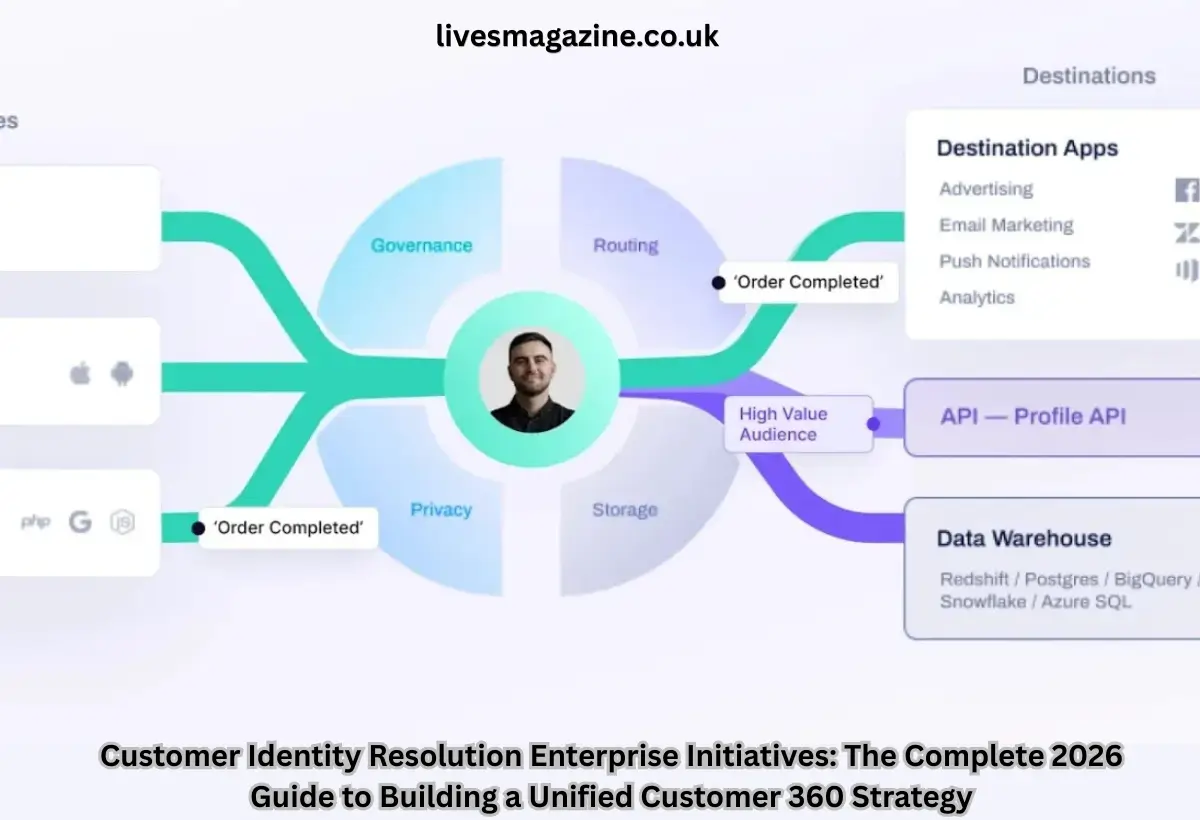
What Are Customer Identity Resolution Enterprise Initiatives?
Customer identity resolution enterprise initiatives are organization-wide programs designed to identify, match, merge, and manage customer identities across multiple systems, channels, and touchpoints.
Rather than storing separate customer records in different databases, enterprises create a unified customer profile that combines every interaction into a single source of truth.
For example, a customer may:
- Purchase products in-store
- Browse products online
- Install a mobile application
- Contact customer support
- Subscribe to email newsletters
- Join a loyalty program
Without identity resolution, each interaction may create a separate customer record. Enterprise identity resolution connects these records using identifiers such as:
- Email address
- Phone number
- Customer ID
- Loyalty ID
- Device ID
- Browser cookies
- Login credentials
- CRM account number
The result is a comprehensive Customer 360 profile that enables every department to work with the same accurate customer information.
Definition of Customer Identity Resolution
Customer identity resolution is the process of identifying multiple customer records that belong to the same individual and merging them into a unified customer profile using deterministic, probabilistic, or hybrid matching techniques.
Instead of treating customers as disconnected data points, identity resolution creates one complete digital identity representing every interaction across online and offline channels.
What Makes an Initiative “Enterprise-Wide”?
Unlike departmental projects, enterprise initiatives involve collaboration between multiple business units, including:
- Marketing
- Sales
- Customer service
- IT
- Data engineering
- Security
- Compliance
- Finance
- Executive leadership
These initiatives typically integrate data from:
- CRM platforms
- Customer Data Platforms (CDPs)
- ERP systems
- Marketing automation software
- E-commerce platforms
- Mobile applications
- Websites
- Call centers
- Point-of-sale systems
- Loyalty programs
The goal is to eliminate data silos and establish consistent customer identities across the organization.
Why Organizations Are Investing in Identity Resolution
Several business trends have accelerated enterprise adoption:
- Rising customer expectations for personalized experiences
- Growth of omnichannel commerce
- AI-powered customer engagement
- Privacy regulations requiring accurate consent management
- Increasing complexity of enterprise data ecosystems
Identity resolution enables organizations to turn fragmented customer information into actionable intelligence.
Why Customer Identity Resolution Matters More Than Ever
Customer expectations have evolved dramatically over the past decade. Consumers expect businesses to recognize them instantly, remember previous interactions, and deliver personalized experiences regardless of the channel they use.
Without identity resolution, businesses struggle to meet these expectations.
Explosion of Customer Data
Every customer interaction creates new data.
Examples include:
- Website visits
- Mobile app sessions
- Product searches
- Purchases
- Support tickets
- Email clicks
- Social media engagement
- In-store transactions
Managing these growing volumes of data requires advanced identity resolution capabilities.
Omnichannel Customer Journeys
Today’s customer journey is no longer linear.
A typical buying journey may involve:
- Discovering a product on social media
- Researching it on a website
- Comparing prices on mobile
- Purchasing in-store
- Contacting support afterward
Identity resolution connects every step into one continuous customer journey.
Privacy Regulations
Global privacy laws such as GDPR, CCPA, and other regional regulations require organizations to maintain accurate customer records while respecting consent preferences.
Identity resolution helps organizations:
- Track consent accurately
- Manage customer preferences
- Improve data governance
- Reduce duplicate personal information
AI-Powered Personalization
Artificial intelligence relies on high-quality customer data.
Unified customer profiles improve AI by enabling:
- Personalized recommendations
- Predictive analytics
- Customer segmentation
- Dynamic pricing
- Intelligent customer service
- Automated marketing campaigns
Increasing Customer Expectations
Modern customers expect businesses to know them.
Examples include:
- Personalized emails
- Relevant product recommendations
- Faster support experiences
- Seamless cross-device interactions
- Consistent messaging
Identity resolution makes these experiences possible.
How Customer Identity Resolution Works
Identity resolution combines multiple technologies into a continuous process that identifies, matches, and updates customer records in real time or batch processing environments.
Collecting Customer Data
The process begins by gathering customer information from various systems.
Typical data sources include:
- CRM platforms
- E-commerce websites
- Mobile applications
- Email marketing software
- Payment systems
- Customer support platforms
- Loyalty programs
- Social media channels
- Offline stores
Every interaction contributes additional customer attributes.
Identity Matching
The identity resolution engine compares incoming records using predefined matching rules.
Common identifiers include:
- Email addresses
- Phone numbers
- Customer numbers
- Loyalty IDs
- Device IDs
- IP addresses
- Login credentials
Advanced systems also analyze behavioral similarities.
Profile Unification
When records belong to the same customer, they are merged into a unified customer profile.
The profile may include:
- Personal information
- Purchase history
- Communication preferences
- Marketing interactions
- Customer support records
- Website activity
- Mobile usage
- Loyalty status
Identity Graph Creation
Many enterprise platforms create an identity graph.
An identity graph maps every identifier connected to an individual customer.
For example:
Customer Jane Smith may have:
- Three email addresses
- Two phone numbers
- One loyalty card
- Multiple devices
- Several browser cookies
- A CRM account
- A mobile app profile
The identity graph links all these identifiers together while maintaining one customer identity.
Real-Time Profile Updates
Modern identity resolution platforms continuously update customer profiles.
Whenever customers:
- Make purchases
- Change contact information
- Browse products
- Contact support
- Join loyalty programs
their unified profile is updated automatically.
Customer 360 Activation
The final stage activates customer data across business systems.
Departments can immediately use updated customer information for:
- Personalized marketing
- Customer support
- Sales recommendations
- Fraud detection
- Analytics
- Business intelligence
Core Components of an Enterprise Identity Resolution Framework
Successful customer identity resolution initiatives depend on several interconnected technologies working together.
Customer Data Sources
Customer information originates from multiple systems.
Common sources include:
- CRM
- ERP
- Marketing automation
- POS systems
- Websites
- Mobile applications
- Customer service software
- Payment gateways
- Data warehouses
Customer Data Platform (CDP)
A Customer Data Platform centralizes customer information from multiple sources.
Its responsibilities include:
- Data ingestion
- Identity resolution
- Customer segmentation
- Real-time activation
- Analytics
CDPs serve as the foundation of many Customer 360 initiatives.
CRM Integration
CRM systems store customer relationships and sales information.
Identity resolution enriches CRM records by combining data from additional sources, ensuring sales teams have complete customer visibility.
Identity Graph
An identity graph stores relationships between customer identifiers.
It continuously updates connections as new interactions occur, reducing duplicate customer records and improving profile accuracy.
Data Lake Integration
Large enterprises often maintain massive data lakes containing structured and unstructured information.
Identity resolution integrates these data repositories, allowing analytics teams to extract richer customer insights.
Data Governance
Strong governance ensures customer information remains:
- Accurate
- Consistent
- Secure
- Compliant
- Accessible
Governance policies define data ownership, quality standards, and lifecycle management.
Privacy Controls
Privacy is central to enterprise identity resolution.
Organizations should implement:
- Consent management
- Role-based access
- Data encryption
- Audit logging
- Data retention policies
- Identity verification procedures
AI and Machine Learning
Artificial intelligence enhances identity resolution by:
- Detecting duplicate profiles
- Improving match accuracy
- Predicting customer behavior
- Automating data quality improvements
- Identifying fraudulent identities
Machine learning models continuously improve as they process more customer data.
Deterministic vs Probabilistic vs Hybrid Identity Matching
Identity matching is the heart of customer identity resolution. Different matching methods offer varying levels of accuracy, scalability, and flexibility.
Deterministic Matching
Deterministic matching relies on exact identifiers to connect customer records. If two records share the same verified email address, customer ID, or loyalty number, they are considered a match.
Advantages
- High accuracy
- Low false positives
- Easy to audit
- Reliable for verified customer data
Limitations
- Cannot match incomplete records
- Sensitive to missing or outdated information
Probabilistic Matching
Probabilistic matching uses statistical models and machine learning to estimate whether two records belong to the same individual, even when exact identifiers differ.
It evaluates signals such as:
- Name similarity
- Address
- Device behavior
- Browsing patterns
- Geographic location
- Purchase history
Each potential match receives a confidence score, allowing organizations to balance accuracy with broader coverage.
Hybrid Matching
Hybrid matching combines deterministic and probabilistic approaches to achieve the best results. Exact identifiers are used whenever available, while AI-driven probability models help connect records with incomplete or inconsistent data.
Which Method Is Best?
There is no single approach that fits every organization. Enterprises handling regulated customer data, such as banks and healthcare providers, often prioritize deterministic matching for precision. Retailers, media companies, and e-commerce businesses typically benefit from hybrid matching because it provides broader identity coverage while maintaining high accuracy.
In practice, hybrid identity resolution has become the preferred enterprise strategy because it balances confidence, scalability, and flexibility.
Reaf Also:- Aspertaan (Aspartame) Explained