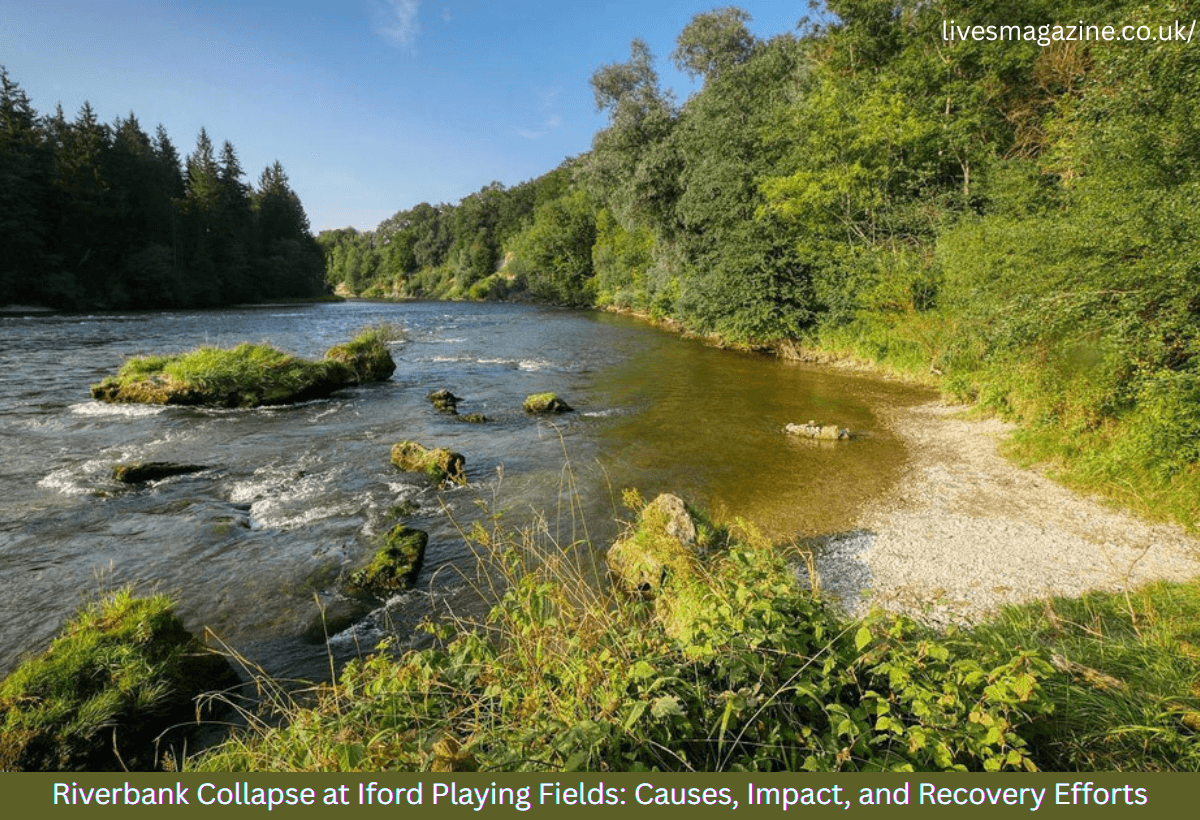
Overview — What Happened at Iford Playing Fields
On a quiet stretch of the River Stour beside Iford Playing Fields, a sizeable section of the riverbank suddenly gave way in late May/October 2025 (local reports first surfaced on 29 May 2025 and follow-up coverage appeared through October 2025). Trees and soil collapsed into the river overnight, leaving a jagged, unstable scar where a popular footpath and riverside green once stood. Walkers, cyclists and families discovered the damage during routine visits; residents reported hearing a low rumble in the early hours and then finding trees and fencing slumped into the water.
The event immediately raised two urgent concerns: public safety (the area is heavily used for walking, cycling and informal recreation) and environmental damage (bank collapse deposits large volumes of sediment into the river, harming aquatic life and removing key vegetation). Local authorities moved quickly to cordon off the most dangerous sections while environmental officers assessed the scale of the collapse and the risk of further failure.
This article explains what caused the collapse, the immediate and longer-term impacts, how officials and the community have responded, and what steps are needed to restore and protect Iford Playing Fields for the future.
The Science Behind the Collapse
How riverbank erosion works
Riverbanks are dynamic systems. The river constantly reshapes its banks through erosion (removing soil and vegetation) and deposition (dropping sediments downstream). Natural erosion is normal, but when erosion accelerates—due to water flow, saturated soils, loss of vegetation, or human activity—banks can fail catastrophically.
Bank collapse typically occurs when the internal cohesion of the soil is reduced and the resisting forces (root strength, soil friction, and bank geometry) can no longer withstand the hydraulic forces exerted by flowing water. In practical terms, this means saturated, loosely consolidated soils with inadequate root systems are especially vulnerable. The presence of undercutting (where the river removes support at the toe of the bank) further destabilizes the slope and can lead to sudden slumps or sections falling away.
Role of heavy rainfall and water saturation
Weeks of heavy rain often precede bank collapses because prolonged precipitation increases soil moisture and pore-water pressure. As soils saturate, their shear strength drops; roots and soil particles that once held the bank together lose grip. If river levels rise quickly—due to storm runoff or upstream flows—the increased hydrostatic pressure and erosive currents can remove the toe of the bank, triggering collapse.
In many modern UK incidents similar to Iford, a combination of high antecedent rainfall and an intense rainfall event acts as the final trigger. Heavy storms in spring or autumn have become more frequent and intense in recent years, increasing the probability of such failures.
Human and environmental factors contributing to instability
Beyond weather, human activity and land management play a major role:
- Vegetation loss or change: Where deep-rooted trees and shrubs are removed, replaced by shallow-rooted grass, the bank loses structural reinforcement. Tree roots bind soil and dissipate energy; their absence accelerates erosion.
- Foot traffic and compaction: Repeated trampling of informal paths compacts the soil and reduces infiltration, changing the way water flows across and through the bank.
- Drainage alterations: Poorly designed surface drainage or blocked culverts can concentrate flows at vulnerable points and accelerate scour.
- Upstream changes: Development, land-use change or river engineering upstream can alter flow regimes, increasing peak discharges downstream.
- Age and geology: Softer, silty banks are far more susceptible to collapse than gravelly or rooted banks.
At Iford, initial accounts point to saturated soils after a period of heavy winds and rain, coupled with natural erosional processes that had been active along the same stretch for some time. The visible collapse was the dramatic outcome of a long-term weakening process.
Immediate Impact on the Area
Damage to trees, paths, and local infrastructure
When a bank collapses, it takes more than soil — it takes community assets. Large trees that once shaded the path pulled out by their roots; benches, fencing and sections of the footpath either slid into the river or were left perilously close to the new edge. The physical damage reduces the amenity value of the playing fields and raises costs for restoration.
Paths immediately adjacent to the collapse are unsafe and must be closed. This disrupts the daily routines of walkers, dog owners, joggers and schoolchildren who use the route. It also reduces the area available for informal play and sport and makes certain recreational activities (like paddleboarding or informal swimming) more hazardous.
Safety risks and restricted public access
Local authorities typically respond to collapses by erecting safety barriers, installing warning signage, and setting exclusion zones. The risk is not only that more soil could give way, but also that the ground beyond the visible edge may be undermined and could collapse without warning. Aside from obvious fall hazards, exposed roots and steep inner slopes present slipping and entrapment risks.
For Iford, council officers cordoned off the immediate area and advised the public to keep clear. Access to adjacent public spaces and some cycle routes may have been temporarily diverted.
Short-term disruption for residents and visitors
Residents reported shock and concern, especially those with mobility issues or who rely on the riverside path as an accessible, level route. Local businesses that depend on footfall (cafés, clubs near the fields) faced short-term reductions in visitors. More broadly, the collapse prompted anxiety about future safety and the condition of other, less-visible stretches of bank.
Response from BCP Council and Local Authorities
Official statements and on-site inspections
Within hours of discovery, the council’s environmental and engineering teams inspected the site to assess immediate risks and plan a response. That included:
- Erecting safety fencing and signage to keep the public out of the hazard zone.
- Commissioning an initial geotechnical survey to determine the stability of adjacent banks.
- Coordinating with conservation partners to examine environmental impacts.
The council confirmed the collapse was part of natural river processes but acknowledged the unusually large section required urgent attention. Monitoring and advice from partner organisations (including internal drainage boards or river authorities) were requested to develop a remediation plan.
Temporary safety barriers and public notices
The visible first line of response is always safety: barriers, directional diversions, and public information. Local communications — council websites, social media channels, and physical signage — are used to update residents and encourage them to avoid the area while work is planned and carried out.
Coordination with environmental experts
Because bank stabilization must balance engineering and ecology, the council often brings in river geomorphologists, ecologists, and civil engineers to design a response that both secures the bank and preserves or restores habitat. This interdisciplinary approach reduces the risk of short-term fixes that damage the river environment.
Environmental and Ecological Consequences
Loss of vegetation and wildlife habitat
Banks and their marginal vegetation are hotspots of biodiversity: they provide nesting and feeding sites for birds, shelter for small mammals, and shade and organic inputs for aquatic life. When a bank collapses large swathes of vegetation are removed instantly, leading to:
- Loss of nesting sites (birds, invertebrates).
- Increased exposure of bankside areas previously shaded and protected.
- Uprooting of flora that provided root reinforcement and habitat structure.
The loss can cause local population declines in sensitive species and reduce ecosystem resilience.
Soil displacement and sediment runoff
One of the most serious short-term ecological impacts is the massive pulse of sediment entering the river. Fine sediments cloud the water, reducing light penetration, clogging fish gills, and smothering invertebrates and eggs on the riverbed. Recovery from a large sediment pulse can take weeks to months depending on flow conditions and sediment characteristics.
Effects on nearby rivers and water quality
Sediment increases can cause temporary but significant deterioration in water quality. This affects not only local biodiversity but also recreational uses and water abstraction points downstream. In sensitive stretches, increased turbidity can reduce oxygen levels and change the thermal characteristics of the river.
Expert Analysis — Why the Riverbank Gave Way
Insights from geologists and environmental engineers
Experts typically look for a confluence of causes. In cases like Iford, the consensus often centers around:
- Progressive undercutting from years of flow erosion at the bank toe.
- Root decay in older trees: while mature trees stabilize banks, once roots decay the support is lost.
- Soil saturation from prolonged wet weather events reducing soil shear strength.
- Vegetation removal or management practices that replaced deep-rooted plants with shallow turf.
Engineers stress that riverbanks are complex; what appears as a sudden failure is often the final stage of a long process. Geotechnical testing (soil cores and slope stability modelling) will help determine precise factors and target effective remediation.
The role of long-term erosion and drainage problems
Where surface or subsurface drainage channels concentrate flows, they can accelerate erosion. Conversely, blocked or inadequate drainage can raise groundwater levels in banks, increasing pore pressures and making slopes prone to sliding. Over time, both factors compound natural erosive action from the river.
Climate change and its impact on Dorset’s river systems
Climate shifts are increasing the frequency of intense rainfall and short-duration storms — conditions that stress river systems and catchments. Higher peak flows increase erosive power at the bank toe; repeated storms allow little time for recovery between events. While no single collapse can be attributed solely to climate change, the broader pattern increases risk and frequency.
Community Reaction and Local Involvement
Eyewitness stories and local concerns
Local residents expressed shock and sadness at the loss of familiar landscapes. Many recounted memories linked to the path and the trees — picnics, dog-walks, school runs — making the collapse feel like a community loss. Social media became a focal point for both worry and sharing practical updates.
Social media coverage and resident discussions
Photos and videos spread quickly, prompting questions about council readiness and landscape management. Some posts accused authorities of inattention; others urged calm and support for a measured response. Community groups used these channels to coordinate help for vulnerable neighbors.
Volunteer and environmental group participation
In many communities such incidents galvanize action. Volunteers can assist with debris removal (under expert guidance), participate in replanting events, and help with community monitoring. Local conservation groups often provide invaluable local knowledge and manpower for long-term habitat restoration projects.
Restoration and Recovery Efforts
Current progress on repair and stabilization
Short-term actions typically include:
- Debris clearance: Removing dangerous fallen timber from the immediate river channel where safe and ecologically appropriate.
- Temporary stabilization: Installing coir rolls, brushwood mattresses, or temporary fencing to reduce immediate erosion.
- Surveying and design: Geotechnical surveys inform permanent solutions.
Longer-term stabilization uses a combination of soft and hard engineering, guided by ecological priorities and budget availability.
Use of eco-friendly erosion control techniques
Best practice moves away from concrete walls toward softer engineering that stabilizes banks while supporting biodiversity:
- Replanting with native trees and shrubs (willow, alder) which have deep root systems and high resistance to periodic inundation.
- Bioengineering measures such as live willow staking, fascines, and coir rolls that provide structure and habitat while consolidating soil.
- Grading and contouring to reduce slope steepness and improve drainage.
- Brush mattresses and root wads to protect the toe from scour while providing fish habitat.
These techniques often succeed in the long term and are more visually and ecologically acceptable than hard armour.
Plans for replanting and landscape restoration
Restoration plans typically include staged replanting with local provenance species, community planting days, and follow-up maintenance for at least two to five years until vegetation becomes established. Where possible, planting mixes include species that flower at different times to support pollinators and provide continuous habitat.
Preventing Future Riverbank Collapses in Dorset
Lessons learned from the Iford incident
- Early monitoring matters. Regular inspections and simple community reporting of cracks, slumping, or unusual drainage can identify hotspots early.
- Vegetation management policies should favor deep-rooting native species in bank zones, and discourage mowing or compaction right at the river edge.
- Integrated catchment planning that considers upstream land use and drainage reduces downstream risks.
- Investment in smart monitoring (pressure sensors, remote cameras, simple level gauges) can provide early warning and allow targeted maintenance.
Modern approaches to riverbank protection
A combined approach of engineered solutions and natural processes is most resilient. When budgets are limited, prioritising high-risk sections and using low-cost bioengineering can deliver significant risk reductions.
Importance of community awareness and climate resilience
Public awareness campaigns that explain safe behaviours (keeping clear of unstable banks, reporting signs of erosion) and encourage participation in planting and monitoring programs help build local resilience. Preparing plans for extreme weather and recovery funding is also crucial as climate impacts intensify.
Public Safety and Visitor Information
Is it safe to visit Iford Playing Fields now?
Officials typically advise avoiding fenced-off areas and keeping to designated diversionary routes. Even areas that appear stable can be undermined beyond the visible edge. Always follow council signage and advice from on-site staff or volunteers.
What to do if you notice signs of erosion
If you see fresh cracks, tree tilting, sudden slumps, or water appearing muddy where it wasn’t before, report it to the local council or environmental agency. If you suspect imminent danger, keep away from the area and alert emergency services.
How the council communicates updates to residents
Councils use a combination of website updates, social media, local press releases, and on-site signage. Subscribing to local council alerts or following official social media accounts ensures you get verified, up-to-date information.
Broader Environmental Context
Riverbank collapses in the UK — a growing trend
Across the UK, stormier seasons and aging infrastructure have increased the frequency of visible erosion and bank failures. While many are small and localized, larger collapses call attention to the need for improved catchment management and investment in natural flood management.
Comparing the Dorset incident with similar cases
Many communities have faced similar events — and have learned that combining community engagement, soft engineering, and catchment thinking yields better long-term outcomes than piecemeal hard fixes. Restoration that prioritises habitat recovery also helps the river adapt naturally.
National strategies for managing erosion and flooding
National guidance increasingly supports natural flood management techniques (woodland planting, restoring floodplains) that reduce peak flows and give rivers room to move. Local projects that align with these strategies often attract technical support and funding partnerships.
FAQs — Everything You Need to Know About the Iford Riverbank Collapse
What triggered the Iford riverbank collapse?
A combination of long-term erosion, saturated soils following heavy rain, and the loss of stabilizing vegetation resulted in a sudden bank failure.
Is the area safe to visit now?
Large sections remain fenced and unsafe for public access. Follow council updates and signage; only approach cleared and re-opened paths when authorities confirm safety.
How long will repairs take?
Short-term stabilization can happen within weeks; permanent restoration and replanting take months to years, depending on funding, seasonal planting windows, and ecological goals.
Will wildlife return?
Yes — many species recover after replanting and stabilization. Some short-term impacts to fish and invertebrates may occur due to sediment, but careful restoration mitigates long-term damage.
How can the community help?
Volunteer replanting, monitoring the site, reporting signs of further erosion, and supporting local conservation initiatives all make a difference.
Conclusion — Learning from Nature’s Warning
The riverbank collapse at Iford Playing Fields is both a local loss and a wider wake-up call. It demonstrates how natural processes — accelerated by weather extremes and subtle human pressures — can suddenly reshape familiar landscapes. The path forward requires a careful blend of engineering skill, ecological sensitivity, community involvement, and long-term planning. When restoration is done well, the site can be safer, greener and more resilient than before.
Iford’s story highlights a hopeful truth: communities that respond with evidence-based restoration, public education, and collective effort can turn a moment of crisis into an opportunity for stronger, more climate-resilient green spaces. The task now is to move quickly, thoughtfully, and inclusively — then to keep listening to the river so that the next warning arrives as a whisper, not a collapse.
Read More:- Glasgow water main break on Shettleston Road