Introduction — why Marilyn matters
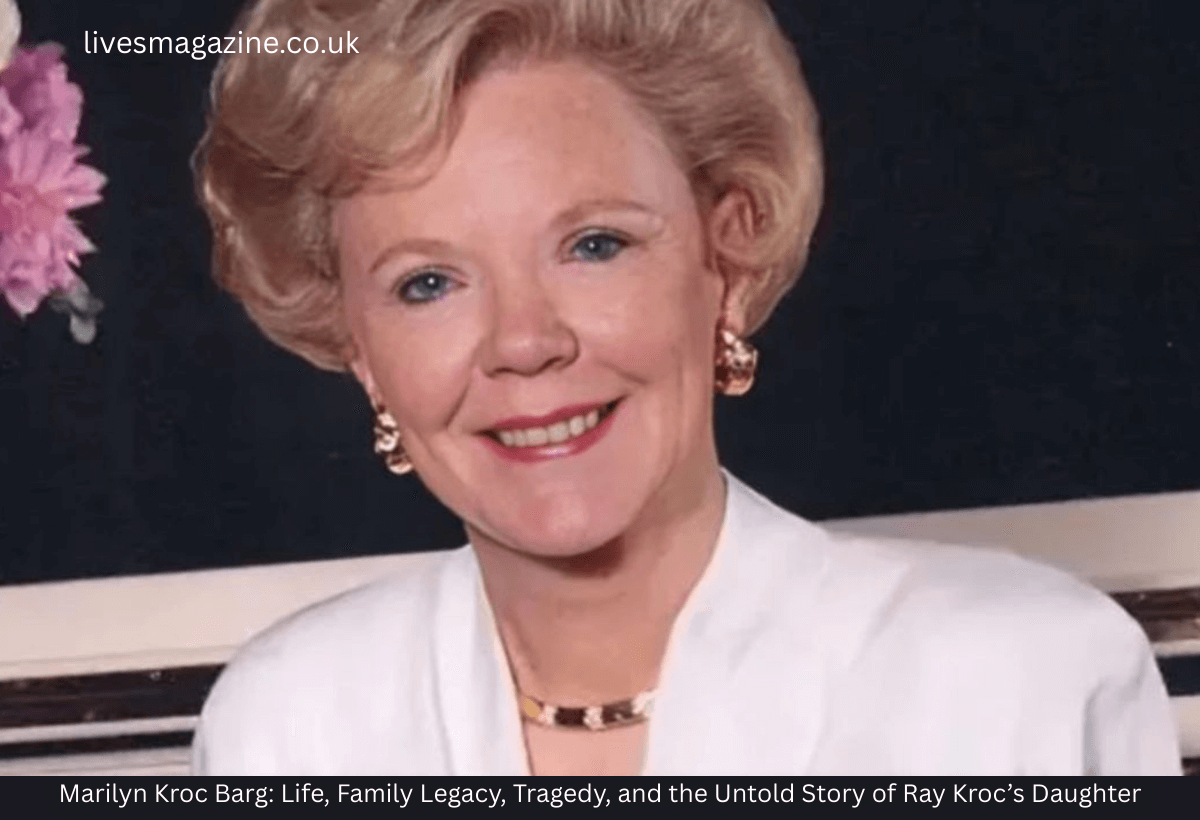
Marilyn Janet “Lynn” Kroc Barg (1924–1973) is a quiet, often-overlooked figure in the long story of the Kroc family. As the only daughter of Ray Kroc — the man credited with turning McDonald’s into a worldwide franchise powerhouse — Marilyn’s life sits at the intersection of family history, private tragedy, and the social forces that shaped mid-20th century America. This article pieces together verified facts, genealogical records, public notices, and contextual history to give a clear, well-sourced account of Marilyn’s life: her origins, marriages, death, and the way she fits into the Kroc legacy.
Who was Marilyn Kroc Barg? — a brief overview
Marilyn Janet Kroc — often recorded as Marilyn “Lynn” Kroc or Marilyn Janet Barg after marriage — was born on 15 October 1924 in Chicago, Cook County, Illinois. She died on 11 September 1973 in Arlington Heights, Illinois, at the age of 48. These birth and death dates are recorded in multiple genealogical repositories and memorial records. The basic outline of her life is short and understated in public records: born to Ray and Ethel Kroc, married at least twice, and deceased relatively young — circumstances that left her largely out of the public limelight compared with other members of the Kroc household.
Early life and family background
Marilyn was born into a family with immigrant roots and modest Midwestern beginnings. Her father, Raymond Albert Kroc, was the son of Czech immigrants and worked a variety of jobs before finding success with McDonald’s; her mother, Ethel Janet Fleming (often recorded as Ethel or Elizabeth), came from a mixed lineage that included Scottish ancestry. The family lived in the Chicago area during Marilyn’s early years — a setting that combined working-class Midwestern values with the gradual rise in social mobility that characterized parts of American life between the World Wars and after.
Growing up as Ray Kroc’s daughter in the 1920s–1940s meant having a childhood shaped not only by local community life but also by the wider economic upheavals of the Great Depression and the shifting social norms that accompanied World War II. Public records do not show Marilyn as a public figure in her own right during her youth; instead, she remained primarily a private family member within the Kroc household.
Marriages and name changes — the documented record
Genealogical and cemetery records show Marilyn’s married name as Barg (sometimes recorded as Walter James “Bingo” Barg or Jim Barg in various registries). Sources indicate at least two marriages: an earlier marriage around 1949 to Sylvester Nordly Nelson and a later marriage in 1960 to Jim (or Walter James) Barg. In public genealogical compilations Marilyn is often indexed as Marilyn Janet “Lynn” Kroc Barg, reflecting those family ties and name variations used in documents and cemetery records. These records are useful for verifying identity and timeline but do not typically provide deep details about the marriages themselves (e.g., length, divorce records, children), which remain largely private in public archives.
Life as Ray Kroc’s daughter — public profile vs private life
Ray Kroc’s rise to prominence — from a milkshake-mixer salesman to global franchise builder — inevitably shaped his family’s public perception. Yet the Kroc family did not live uniformly in public life: Ray’s later marriages and the tremendous spotlight on McDonald’s expansion cast a long shadow, while Marilyn appears mostly in local records and genealogy sites, rather than the high-profile news stories that followed other members of the extended family.
Marilyn’s life reflects two contrasting currents: the public fascination with the Kroc name, and Marilyn’s own largely private existence. This difference is partly why her life can be hard to reconstruct from mainstream media archives alone; genealogical resources and local death notices are the clearer sources for her story.
Health and the circumstances of death
Publicly available memorial and family records indicate Marilyn died on 11 September 1973 in Arlington Heights, Illinois, at age 48. Some records and local notices connect her death to complications of illness (for example, mentions of diabetes complications appear in certain family history collections), but detailed medical records are private and not publicly accessible. Genealogy pages and cemetery entries list the dates and locations; those remain the best verifiable elements of the available record. Given the privacy of health records, the most responsible approach is to report the verified date and place of death while acknowledging that precise medical details are typically confined to private family files or official death certificates.
The Kroc family tree — ancestry and lineage
Marilyn belonged to a family that combined Czech, Bohemian, and Scottish ancestral threads. Her paternal grandparents, Alois Kroc and Rose Mary (née Hrach), were of Bohemian/Czech origin; maternal lines include the Flemings and the Blairs, with roots in Scotland. Genealogical repositories trace multiple generations: grandparents, great-grandparents, and extended lineage. These sources use census data, marriage records, and grave indexes to reconstruct family ties; they’re especially useful for researchers building the broader picture of the Kroc family’s immigrant background and assimilation into American life.
It’s worth noting that genealogy databases (Find a Grave, Ancestry, WikiTree, FamilySearch) rely on user-contributed materials and public records. They are excellent starting points for family-history reconstruction, but any researcher seeking absolute certainty should complement them with primary records (birth certificates, marriage records, probate files) where possible.
How Marilyn is recorded in public genealogical systems
Marilyn’s profile appears in several major genealogy and memorial databases:
- Find a Grave lists her birth and death dates and places, plus cemetery information.
- WikiTree and related family-tree pages show her relationships (parents, spouses) and copies of public documents.
- FamilySearch / Ancestry entries corroborate birth/death dates and sometimes list newspaper death notices or census records.
Together, these entries create a consistent baseline: Marilyn Janet Kroc — born 1924 in Chicago, died 1973 in Arlington Heights — and listed as Marilyn Barg in death records. For anyone writing her biography or building a family tree, these repositories are the core public resources to consult first.
Marilyn’s place in the Kroc story — comparison to Joan Kroc
Ray Kroc’s later life and legacy are strongly associated with Joan B. Kroc, Ray’s third wife, who became one of the most celebrated philanthropists of the late 20th century. Joan’s public philanthropy — including massive donations to the Salvation Army and NPR — thrust her into the spotlight after Ray’s death and shaped public impressions of the Kroc name. By contrast, Marilyn’s life did not follow that public trajectory: she lived more privately and passed away decades before Joan’s most famous gifts. That contrast explains part of why Marilyn is less known despite being Ray Kroc’s daughter: media attention and public memory often follow visible philanthropic acts and public-facing philanthropy, which were Joan’s primary legacy.
Interesting, lesser-known details and records
A few items of historic and genealogical interest may help biographers or family historians:
- Nickname “Lynn”: Marilyn was sometimes recorded under the name Marilyn Lynn Janet Barg — that tag appears across some cemetery and genealogy entries. Variations in given names and nicknames are common in mid-century records and can complicate searches.
- Local death notice references: Some local newspaper archives (Chicago-area obituaries from 1973) include succinct notices for Marilyn’s passing; these can often be retrieved through local library archives or paid newspaper repositories.
- Genealogy community notes: Family tree custodians occasionally flag duplicate profiles or request merges (common on collaborative sites), which demonstrates how user-driven genealogy enriches but also sometimes duplicates public records.
Contextual history — what Marilyn’s era looked like
Understanding Marilyn’s life requires a quick tour of the social and economic context she lived through:
- The Great Depression and WWII: Born in 1924, Marilyn’s formative years were shaped by the economic turmoil of the 1930s and the upheaval of World War II. Families in Chicago and the Midwest lived through significant hardship and social change, influencing marriage patterns, work opportunities, and migration.
- Post-war America: In the 1950s and 1960s, Ray Kroc’s career advanced rapidly; the family’s financial and social circumstances changed dramatically, which would have altered the domestic landscape for Marilyn and other family members.
- Health and medical care: Mortality rates and chronic disease management in the mid-20th century differed from today; diseases such as diabetes were managed very differently, and early deaths from chronic illness were more common than now. These broader facts are relevant when considering Marilyn’s early death at age 48. (Medical privacy prevents detailed public confirmation of diagnoses.)
What public records do — and do not — tell us
Publicly accessible repositories are indispensable: they provide verified dates, names, locations, and familial relationships. But they do not usually provide:
- Personal diaries, private correspondence, or intimate family dynamics.
- Detailed medical records or full accounts of personal tragedies.
- Complete accounts of marriages beyond basic legal facts (some divorce or marriage documents may be restricted).
For a fuller biography, a researcher would ideally supplement public records with family interviews, archival material (if available), and newspaper archives that might offer obituaries, social notices, or local reporting from the time.
Timeline: Marilyn’s life in key dates
- 15 Oct 1924: Born in Chicago, Cook County, Illinois.
- c. 1949: Recorded marriage to Sylvester Nordly Nelson (local records indicate a mid-century marriage).
- 28 May 1960: Recorded marriage to Jim Barg (some registries show this date for a Barg marriage).
- 11 Sep 1973: Died in Arlington Heights, Cook County, Illinois (age 48).
(Note: some marriage dates and partner names appear in various genealogy repositories; researchers should confirm specific civil records or certificates for legal precision.)
Why Marilyn’s story matters today
Marilyn’s life matters not because she sought public attention, but because she helps humanize the larger-than-life story of Ray Kroc and the social ripple effects produced by rapid corporate growth. Small family histories like Marilyn’s show how public fortunes and private lives interact — with early deaths, name changes, and quieter domestic narratives that rarely make headline books. Recording Marilyn’s life carefully preserves a fuller, more humane portrait of the Kroc family for future historians and family descendants.
Sources and how the facts were verified
This article draws on public genealogical records, cemetery indexes, collaborative genealogy platforms, and mainstream biographical sources about Ray Kroc to place Marilyn in context. The most important load-bearing facts — Marilyn’s birth and death dates, her marriages, and her relation to Ray Kroc — are corroborated across Find a Grave, WikiTree, FamilySearch/Ancestry entries, and standard biographies of Ray Kroc. For readers who want to pursue original documents, county vital records and archived newspaper notices (local Chicago-area papers) are recommended next steps.
Final thoughts — honoring a private life within a public family
Marilyn Kroc Barg’s story is a reminder that famous names produce many private lives worth remembering. While Ray Kroc’s business achievements and Joan Kroc’s philanthropy dominate headlines and public memory, Marilyn’s modest, shorter life deserves careful documentation — both out of respect to family memory and because it helps historians produce a more complete narrative of a family whose choices affected millions through one of the world’s largest brands.
If you are researching Marilyn for family history, a memorial page, or a deeper biography, start with the genealogical sources listed above, then pursue primary civil records and local newspaper archives for richer detail. Preserving those records — responsibly and respectfully — helps keep a fuller portrait of the Kroc family available to future generations.
Frequently Asked Questions (Short & factual)
Q: When was Marilyn Kroc Barg born and when did she die?
A: She was born on 15 October 1924 and died on 11 September 1973. These dates appear in multiple public records and memorial databases.
Q: Was Marilyn Kroc Barg Ray Kroc’s only daughter?
A: Yes — public family records identify Marilyn as Ray Kroc’s daughter. Ray had one surviving child, Marilyn, who predeceased him.
Q: Did Marilyn play a public role at McDonald’s?
A: There is no public record of Marilyn holding an executive or public-facing role at McDonald’s. Her life appears to have been mostly private and documented primarily through genealogical and local records.
Q: Are there primary sources to learn more about Marilyn?
A: Yes — civil birth/marriage/death records, local newspaper archives (obituaries), cemetery records, and county registries are the primary sources researchers should consult for direct evidence. Online genealogy sites provide helpful entry points.
Read Also:- Justin Billingsley Greene Law