Introduction
Social media platforms are constantly experimenting with ways to make connections feel more engaging and meaningful. Snapchat’s Solar System feature does exactly that — it gamifies friendship by assigning your top contacts to planets based on how often you communicate and interact with them. This provides a unique graphical way to visualize social dynamics on Snapchat.
Let’s embark on a journey through this digital cosmos and uncover what each planet means, how Snapchat decides your ranking, and what it all means for your friendships.
What Is Snapchat Solar System?
The Snapchat Solar System — also called Friend Solar System — is a premium feature available exclusively for Snapchat Plus subscribers. In this system:
- You are the Sun in the center of your personal universe.
- Your top 8 closest friends orbit around you as planets.
- The closer they are to you (the Sun), the stronger your interaction with them — based on Snaps, chats, streaks, and more.
This isn’t a public leaderboard: the ranking is private and only visible to you (and sometimes only when you visit a specific friend’s profile).
What Is Snapchat Plus?
Snapchat Plus is Snapchat’s paid subscription tier that unlocks exclusive, experimental features not available to free users. It launched on June 29, 2022, and has grown rapidly. As of late 2025, Snapchat+ has more than 16 million subscribers worldwide, with that number having more than doubled since early 2024 — proving its popularity among Snapchat users.
What Snapchat Plus Offers
Snapchat Plus includes a growing suite of perks such as:
- Custom app icons
- Bitmoji backgrounds
- Priority story replies
- Unique badges
- Friends Solar System (planets feature)
- Story rewatch indicators
- Custom chat wallpapers and more
The Solar System feature itself is only accessible to Plus subscribers, meaning you must be subscribed to view your digital planetary rankings.
How Snapchat Solar System Works
At its core, the Snapchat Solar System works by analyzing your interaction data — including Snaps sent and received, chat frequency, snap streaks, and sometimes story engagement — to determine how close you are to each friend. Those with the highest engagement end up closest to the Sun (you), while less frequent interactions place friends further away.
Here’s how Snapchat essentially processes your data:
- Frequency of interactions – how often you send messages, snaps, and chats.
- Snapstreaks – longer streaks can influence closeness.
- Engagement – how often you view or react to a friend’s content.
- Recency – recent interactions weigh more than older activity.
Importantly, Snapchat recalculates this system dynamically — meaning your planets can move closer or further depending on how often you interact with friends over time.
Snapchat Solar System Algorithm (In-Depth)
While Snapchat doesn’t publicly disclose its exact algorithm, the basic logic is:
- Higher activity = closer planet
- Combined interactions matter — not just one metric
- The system updates regularly as engagement patterns change
- Privacy is preserved — nobody else sees your exact data or ranking unless they check it in their own view.
So if Friend A sends you snaps and chats daily, while Friend B only sends story replies occasionally, Friend A will likely be Mercury (your #1 spot) and Friend B may be far out like Uranus or Neptune.
Snapchat Planet Order Explained (Best Friends Ranking)
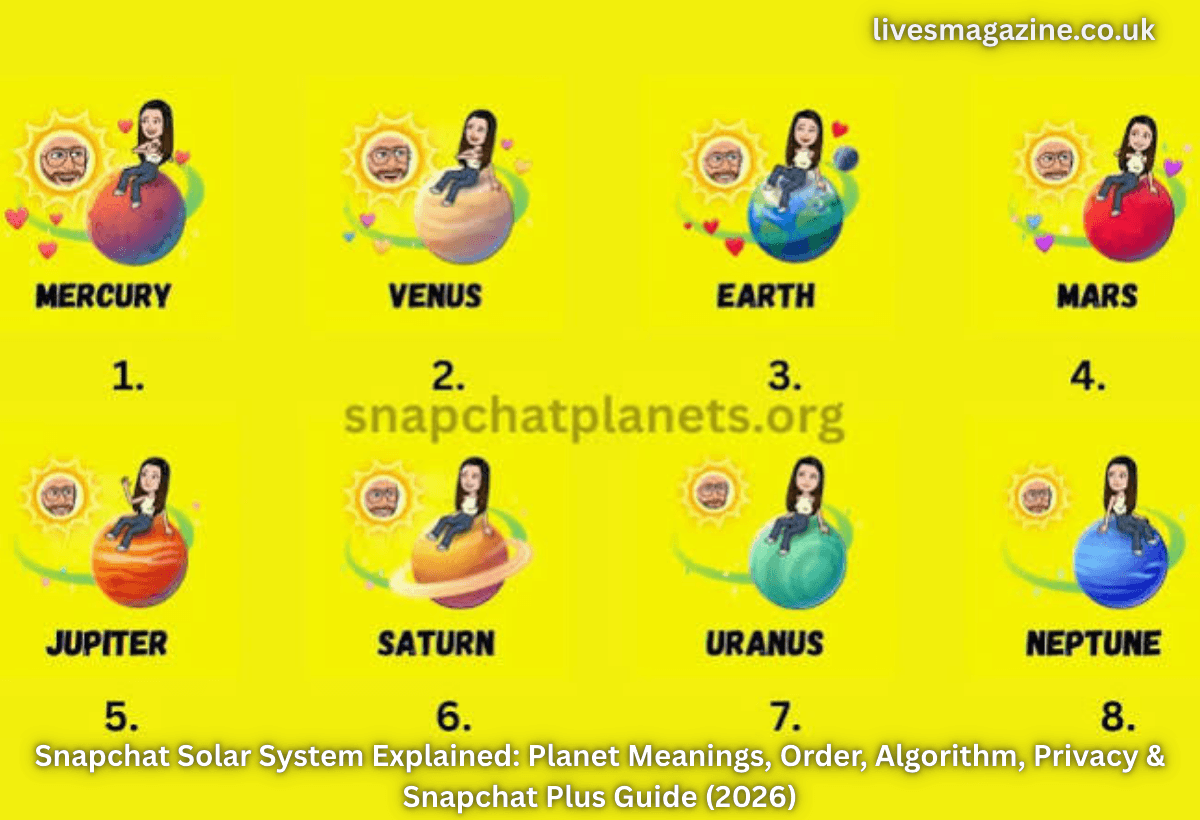
The Snapchat Solar System includes eight planets, each representing a position in your Top 8 Best Friends list. The order follows the real solar system’s structure:
1. Mercury – Closest Best Friend
Meaning: Mercury is the planet closest to the Sun — and in Snapchat’s system, this means your #1 closest friend.
This person interacts with you the most and has the most combined chats, snaps, and streaks.
2. Venus – Second Closest Friend
Meaning: Venus represents your second most interacted friend.
They’re active with you, but slightly less than Mercury.
3. Earth – Third Best Friend
Meaning: Earth suggests a strong relationship — regular chats, decent streaks, and frequent engagement.
4. Mars – Fourth Best Friend
Meaning: Mars reflects a friend you interact with often, but not as much as the top tier.
5. Jupiter – Fifth Best Friend
Meaning: A somewhat active friend — still part of your inner circle, but not deeply.
6. Saturn – Sixth Best Friend
Meaning: Someone with whom you have occasional interactions.
7. Uranus – Seventh Best Friend
Meaning: Lower communication frequency — you might communicate just on special occasions.
8. Neptune – Eighth Best Friend
Meaning: This friend is still in your Top 8, but the relationship is distant compared to others.
What Snapchat Planet Colors and Hearts Mean
Snapchat also uses visual cues — such as colors and heart emojis — to convey friendship intensity. For example, red hearts often signify stronger engagement, while other colors indicate varying degrees of interaction.
Although the exact heart meaning can vary in different UI updates, generally:
- – close engagement
- – significant but not top-tier – mutual friendships– special connection indicators
These layers help users easily recognize where they stand with each friend.
How to See Snapchat Solar System (Step-by-Step)
Here’s how you can view your friend’s Solar System on Snapchat:
- Open the Snapchat app
- Go to your Chat list
- Tap the friend’s Bitmoji/profile
- Tap the Friends badge or Best Friends icon
- See which planet you or they represent and what their position is.Note: You must have Snapchat Plus and have the Solar System feature toggled on in your settings to see it.
Snapchat Solar System Not Showing? (Fixes)
If the Solar System doesn’t appear, try these:
- Ensure you have Snapchat Plus and the feature is turned on.
- Make sure you’re using the latest version of Snapchat.
- The friend must be on Snapchat too.
- Try restarting the app or clearing the cache.
Some users report occasional display bugs, especially if Snapchat is rolling out updates. This is more common on Android. User experiences vary.
Snapchat Solar System vs Snapstreaks
While both features measure interaction, they serve different purposes:
- Snapstreaks count consecutive days of dispatching snaps between you and a friend.
- Solar System planets show your overall interaction rank across multiple engagement types.
A high streak doesn’t always guarantee a high planet position, but it helps.
Psychological and Social Impact of Snapchat Solar System
Games and visuals like these can be fun — but also exert social pressure. Snapchat has acknowledged that streaks and similar features can create anxiety around maintaining engagement.
Positive Effects
- Encourages connection
- Makes friendships feel meaningful
- Helps users visualize social priorities
Negatives
- Can stress users about rankings
- May trigger comparison anxiety
- May feel competitive among teens
Snapchat made the Solar System optional partly because of privacy and well-being concerns — acknowledging that not everyone wants constant visibility into social metrics.
Privacy and Safety Concerns
Despite being interactive, the Solar System doesn’t expose message content or exact usage data.
- Only Snapchat+ users can see the feature
- Your ranking isn’t shown to others unless they view it on their own app
- Snapchat does not show other friends’ planets unless you have access
These privacy safeguards help ensure this remains a fun feature without compromising personal data.
Parental Controls and Snapchat Solar System
Parents should know:
- There’s no direct “parental control” just for the Solar System, but Snapchat Family Center lets guardians monitor overall usage.
- Since Solar System may influence social pressure, parents might choose to discuss healthy usage rather than ban it outright.
Understanding how the feature works helps parents guide younger users about healthy engagement.
Educational Value of Snapchat Solar System
While it’s just a social feature, it’s also unintentionally educational:
- Introduces users to planet order from Mercury to Neptune
- Encourages thinking about interactions beyond numbers
- Provides a visual metaphor for closeness
Even casual learners can use this to remember the real solar system order — a fun bonus to friendship metrics.
Can You Change or Improve Your Snapchat Planet?
Yes — but organically:
- Increase quality interactions
- Send Snaps and messages consistently
- Maintain streaks with friends
- Engage with their stories or content
Just spamming interactions may look forced; genuine conversation tends to be more meaningful.
Frequently Asked Questions (FAQs)
Q: How many best friends can you have on Snapchat?
A: You can have many friends, but the Solar System feature only ranks the Top 8.
Q: Can someone see their planet in your Solar System?
A: Only if they have Snapchat Plus and you have the feature enabled.
Q: Does Snapchat notify when planets change?
A: No — changes happen silently.
Q: Is the Snapchat Solar System permanent?
A: No — it updates with interaction trends.
Future of Snapchat Solar System
Snapchat continues to evolve — experimenting with more customization, augmented reality features, and deeper analytics that may one day bring more insight into social interaction trends.
Final Verdict
The Snapchat Solar System is both playful and insightful. It visually represents relationship strength based on engagement metrics, giving users a clear understanding of where they stand with their closest friends. While it’s a Snapchat+ exclusive, the value it adds — combined with the social gamification — makes it a standout feature among modern social apps.
Whether it’s worth the subscription depends on how much you value visualization tools and enhanced social experiences in Snapchat.
Read More :Labarty Explained