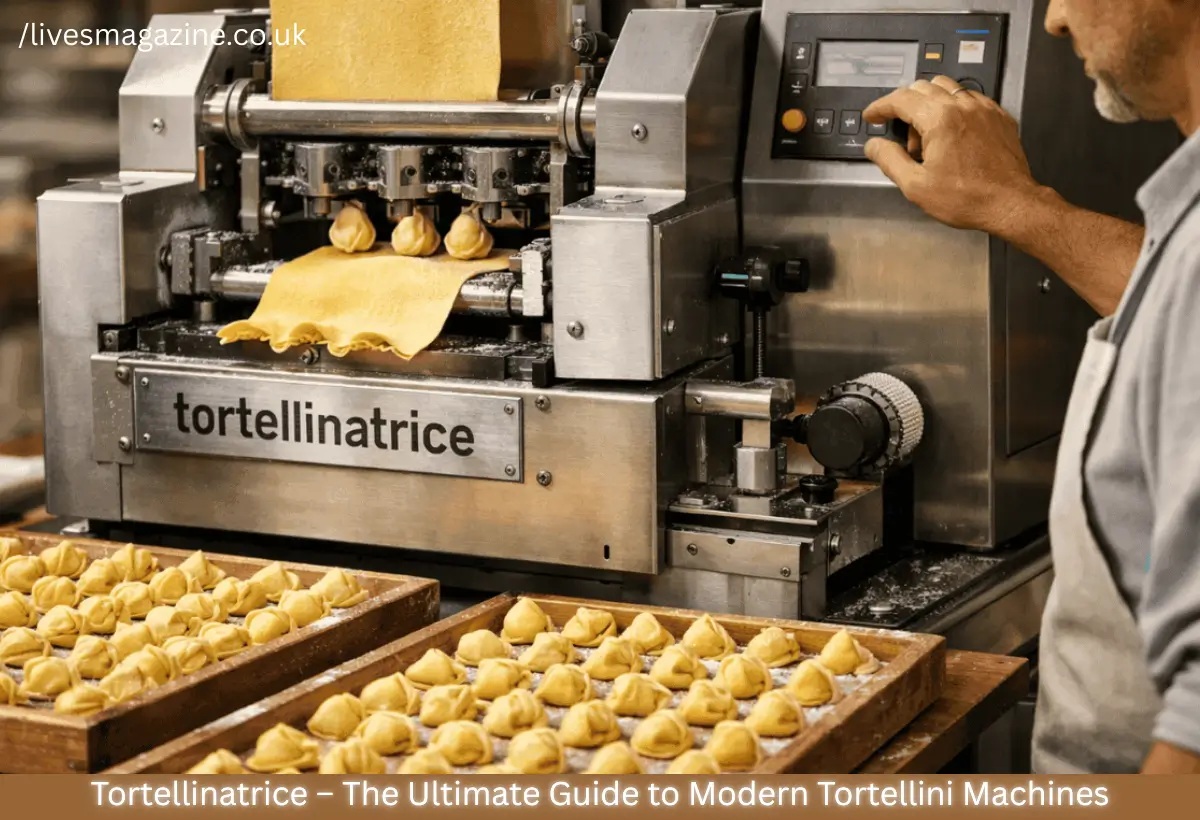
What Is a Tortellinatrice? Understanding the Machine
A tortellinatrice is a machine designed for producing tortellini (and similar stuffed pasta) at scale. Unlike simple pasta rollers, this specialized equipment handles multiple critical functions:
- It advances a sheet of pasta dough at consistent thickness.
- It feeds and meters filling into the center of dough portions.
- It folds and seals the dough around the filling to create the classic tortellini shape and ring.
- It cuts the sealed tortellini into individual pieces.
The goal is not just speed, but precision: replicating the shape, filling distribution, and seal quality that traditional hand-made tortellini offer — but with vastly greater output, consistency, and less manual labor.
As one specialty site explains, a tortellinatrice “automates the process of rolling, portioning, sealing, and cutting that would otherwise require hand folding.”
The Evolution of Tortellini Machines
Early Manual Models
Historically, tortellini was shaped entirely by hand, often by sfogline (women who specialized in pasta-making). As demand grew — especially in restaurant and industrial contexts — innovators developed early machines. According to OMZ’s history, in the early 20th century they manufactured a machine able to produce 5,000 pieces per hour, a feat that once required dozens of workers.
Semi-Automatic and Fully Automatic Models
Over time, tortellinatrici evolved into semi-automatic and fully automatic versions. Semi-automatic machines allow human oversight (for example, loading dough and adjusting settings), while automatic versions handle continuous sheet feeding, metered filling, folding, sealing, and cutting — with minimal manual intervention.
One modern example is the Ostoni T8: an 8-piston machine that produces around 130 kg/hour, with continuous filling feeder, double calibrator rollers, and scrap-cutting — all in a machine built in food-grade stainless steel.
Why This Evolution Matters
This shift from manual to mechanized production allows for:
- huge increases in throughput,
- consistent product shape and quality,
- reduced waste and labor costs,
- scalable production for restaurants, pasta labs, and large factories.
How a Tortellinatrice Works (Full Production Workflow)
A tortellinatrice performs multiple steps in sequence, each one critical to producing high-quality tortellini.
- Dough Feeding and Rolling
Dough prepared in a mixer or dough extruder is fed into the machine. Rollers (calibrators) flatten the dough into a sheet of uniform thickness. The thickness can often be adjusted to match the type of pasta or desired bite. - Filling Metering
Filling (meat, cheese, vegetables, etc.) is metered precisely into the center of dough portions via a filling pump or dosing system. The portion size must be carefully controlled: too much causes breakage, too little leads to hollow pockets. - Folding & Sealing
The dough is folded around the filling using guiding mechanisms. Then pressure is applied (mechanical or pneumatic) to seal the edges. This step is critical: a good seal ensures the filling stays inside while cooking. - Cutting
Once sealed, individual tortellini are cut by a blade or cutting mechanism. The cutters must be sharp and accurate to avoid deforming the pasta. - Ejection & Handling
Finished tortellini are gently ejected into trays, pans, or onto conveyors. Some machines stage them so they can be dried, refrigerated, or cooked.
Many modern machines also offer programmable settings (via electronic or digital control) for dough thickness, fill amount, speed, and cycle recipes — making production more flexible and repeatable.
Types of Tortellinatrice Machines
There are several types of tortellinatrici, suited for different scales and uses:
Manual vs. Automatic
- Manual Tortellinatrice
Operated by hand or with minimal automation. Best for small kitchens, boutique pasta shops, or artisan makers who prioritize control over volume. - Semi-Automatic
Combines mechanized functions (like filling) with some manual control (like feeding dough). Good for small to medium production with variable recipes. - Fully Automatic
Designed for high-volume operations: continuous dough feed, automatic folding, sealing, cutting. Ideal for pasta factories, catering central kitchens, or large restaurants.
Home, Professional, and Industrial Models
- Home Models
Compact, simple, easy to disassemble and clean. Perfect for cooking enthusiasts. - Professional / Restaurant Models
Durable stainless steel construction, heavier motors, faster throughput, but maintain manageable footprint for kitchen counters. - Industrial / Factory Machines
High capacity, continuous feed, integrated conveyors, modular molds, and food-industry grade automation. Example: Omаr 540 Standard, with multiple “punches” for different sizes.
Molds, Sizes & Upgrades
- Mold Options: Many tortellinatrici support interchangeable molds so you can make different sizes (mini tortellini, regular, tortelloni).
- Upgrades: Variable speed drives, larger filling hoppers, energy-efficient motors, and modular attachments (for ravioli, cappelletti) increase flexibility.
- Advanced Features: Some models also clean or cut off scrap automatically, improving hygiene and reducing manual cleaning.
Key Features of Modern Tortellini Machines
When evaluating a tortellinatrice, here are some critical features to look for:
- Stainless-Steel Construction
Food-safe materials are essential for hygiene and longevity. Many machines use stainless steel for all parts that contact dough or filling. - PLC / Electronic Control
Digital or PLC (Programmable Logic Controller) systems enable precise control over speed, filling, dough loop, and production recipes. - Double Calibrator / Loop Control
The machine should evenly stretch and measure the dough sheet to maintain quality and consistency. - Continuous Filling System
A well-calibrated filling feeder ensures consistent filling portions and reduces waste. - Sealing / Compression Mechanism
Reliable sealing (either mechanical or pneumatic) ensures that tortellini don’t open during cooking. - Scrap-Cutting / Removal
Modern machines often cut away excess dough (“scrap”) and divert it or recycle it, which helps with hygiene and reduces waste. - Touch-Screen / Recipe Storage
Touchpanel allows operators to select programs, save recipes, and adjust production on the fly. - Easy Maintenance
Machine parts should be easy to disassemble for cleaning — crucial in food production for sanitation.
Benefits of Using a Tortellinatrice
Speed & Throughput
With a machine, production rates can increase dramatically. For example, the Ostoni T8 tortellinatrice has an hourly capacity around 130 kg of tortellini.
This speed translates to shorter batch times, enabling restaurants and pasta factories to produce more without compromising quality.
Consistency & Quality
Because the machine precisely meters filling and seals each piece, every tortellino comes out uniform in size, shape, and taste. This ensures consistent cook times and presentation — essential in professional kitchens.
Labor Efficiency
A tortellinatrice reduces repetitive manual folding and shaping. Staff can focus on higher‑value tasks (recipe innovation, finishing, sauce preparation), which improves productivity and morale.
Cost & Waste Reduction
Accurate filling dosing and minimal scrap help reduce filling waste. Also, because sealing is reliable, fewer pieces burst during cooking (“floaters”), reducing loss.
Hygiene & Safety
With food-grade stainless steel parts, automated scrap removal, and surfaces designed for easy cleaning, these machines help maintain high hygiene standards required by food production regulations.
Versatility
Modern tortellinatrici can handle different recipes (meat, cheese, vegetable fillings) and dough types (egg dough, spinach dough, etc.). Interchangeable molds support various sizes – from tiny tortellini to larger tortelloni.
Tortellinatrice in Restaurants, Pasta Shops, and Factories
- Restaurants & Trattorie: Many chefs use tortellinatrici to scale their tortellini production while preserving traditional flavor and shape.
- Boutique Pasta Shops: Small pasta labs or artisan shops can produce high-quality tortellini with less labor and faster turnaround.
- Large Pasta Factories: Industrial machines integrate into automated production lines (mixers, sheeters, conveyors) to deliver massive volumes. For example, Pagani Industrie Alimentari’s production process uses configured lines that form tortellini and ravioli from dough and filling.
- Export and Retail: With machines, companies can produce consistent tortellini for frozen or packaged ranges, maintaining authenticity at scale.
Innovations and Future Trends in Tortellinatrice Machines
Digital Controls & Recipe Management
Modern machines feature touchscreen interfaces, recipe memory, and programmable parameters, making it easy to switch between products and optimize production.
Energy Efficiency
Manufacturers are designing motors and systems that are more energy-efficient, helping to reduce consumption and running costs.
Compact Design
Smaller but powerful tortellinatrici are emerging for tight kitchen spaces, enabling even small restaurants or food entrepreneurs to harness automation.
AI / Smart Sensors
Emerging models may use smart sensors to adjust filling in real time, predict maintenance needs, and reduce downtime — aligning with trends in Industry 4.0.
Multi‑Shape Machines
Some machines are being designed to handle not just tortellini, but ravioli, cappelletti, and other stuffed pasta with modular attachments.
Common Misconceptions About Tortellini Machines
- “Machines ruin authenticity.”
Not necessarily. High-quality tortellinatrici replicate hand-folded shapes with precision, retaining the signature fold and texture. - “Only big factories need them.”
While industrial versions exist, small and semi-automatic machines are ideal for restaurants, catering, and artisan pasta makers. - “They are too complicated to maintain.”
Modern designs emphasize easy-to-clean parts, quick disassembly, and user-friendly controls. Training and maintenance plans are often provided. - “They don’t save money.”
On the contrary: reduced labor, consistent yield, and lower waste often mean ROI in a relatively short time.
Italian Culinary Heritage and the Role of Tortellinatrice
Tortellini are deeply rooted in Italian gastronomic tradition, especially in Emilia-Romagna (Bologna, Modena). Family pasta makers, trattorias, and artisan labs have crafted them by hand for centuries. But as demand grew, innovators introduced machines to maintain that tradition at scale — without losing authenticity.
A famous example: one Italian restaurant in Los Angeles (Pasta Sisters) uses a tortellini machine that’s Italy-approved to produce traditional Bolognese tortellini exactly like in Emilia-Romagna.
The dedication to tradition is real: they even adopted a machine certified by the Chamber of Commerce of Bologna.
Companies like Facchini Group, founded in 1959, manufacture high‑quality pasta production machines (including tortellinatrici) that are used worldwide.
These partnerships between heritage pasta-makers and machine manufacturers help preserve Italian culinary craftsmanship while meeting global demand.
Choosing the Right Tortellini Machine
When selecting a tortellinatrice, weigh the following factors:
Capacity & Production Volume
Estimate your daily or weekly tortellini production. For low to moderate volume, a semi-automatic or compact machine might suffice; for large-scale production, an industrial machine with high throughput is better.
Automation Level
Do you need full automation or manual control? Fully automatic machines are ideal for continuous production, while semi-automatic ones are more flexible for recipe experimentation.
Materials & Hygiene
Look for food-grade stainless steel, minimal crevices for cleaning, and easy disassembly. Machines like Omar 540 offer fully stainless construction and are designed for industrial hygiene standards.
Mold Options
Consider whether you need interchangeable molds (for different tortellini sizes or styles). This increases flexibility without requiring separate machines.
Support & Maintenance
Choose a brand or supplier that offers spare parts, technician support, and training. This ensures long-term reliability and reduces downtime.
Price & ROI
Calculate the cost of the machine against expected savings in labor, waste, and increased output. Consider also energy consumption and maintenance costs.
Step‑by‑Step: Using a Tortellinatrice
- Dough and Filling Prep
Prepare dough (e.g., “00” flour and eggs) and filling (meat, cheese, or vegetables). Make sure fillings have consistent texture to avoid damaging seals. - Machine Calibration
Adjust dough thickness, filling portion, speed, and sealing pressure. Run test batches to fine-tune settings. - Production Run
Feed dough, let the machine meter the filling, fold, seal, cut, and eject the tortellini. Monitor the flow to ensure quality. - Quality Check
Sample a few pieces, cook them, and test for sealing, consistency of shape, and taste. Adjust settings if necessary. - Storage or Finishing
Transfer tortellini to trays for drying, packaging, or immediate use. Clean and sanitize the machine parts per hygiene protocols.
Real-World Examples & Specifications
- Ostoni T8: Produces ~130 kg/hour; 8 pistons; stainless casing; 380 V power; sheet width 540 mm.
- Officina DEA D140: ~25 kg/hour for fresh pasta shops.
- Officina DEA D250: ~50 kg/hour for larger operations.
- OMAR 540 Standard: Available in various punch configurations (mini, medium, tortelloni), produced by a company with 70+ years of experience.
These numbers help you match the right machine to your production goals — whether making a few dozen tortellini a day or thousands.
Innovations and the Future of Tortellinatrici
- AI and Smart Sensors: Emerging machines could use real-time sensors to adjust filling portion or sealing pressure automatically.
- Energy Efficiency: Brands are designing faster, lower-energy motors to reduce power consumption.
- Compact & Modular Machine Design: For small kitchens or startups, smaller tortellinatrici with modular attachments make production scalable.
- Multi‑Shape Machines: Machines that switch between tortellini, ravioli, and other stuffed pastas help expand menu offerings.
Common Misconceptions About Tortellini Machines
- “Only big pasta factories can use them.”
- False: There are machines for home cooks, restaurants, and small labs.
- “Machines compromise authenticity.”
- Not necessarily: High-end machines replicate the traditional seal, shape, and texture, preserving quality.
- “They’re too hard to clean.”
- Modern machines are built for food-safe parts and easy cleaning, with stainless steel and modular design.
- “Maintenance will be a nightmare.”
- Good manufacturers provide spare parts, documentation, and training to minimize downtime.
Conclusion
The tortellinatrice is a beautiful convergence of tradition and technology: a machine that respects the artistry of handmade tortellini while boosting efficiency, consistency, and scalability. Whether you’re a small restaurant, an artisan pasta maker, or a large-scale manufacturer, choosing the right tortellinatrice can transform your production process.
With modern features like programmable controls, stainless-steel hygiene, and modular molds, these machines make it possible to produce authentic tortellini in volume — without sacrificing quality. And as technology continues to evolve, we can expect even smarter, more efficient tortellini production in the years to come.
A tortellinatrice isn’t just a pasta machine — it’s a legacy tool, helping bring the heart of Italian culinary tradition to the modern kitchen.
Read About:- Scrap My Van